SKOCH Summit
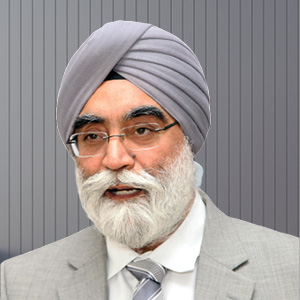
Prof Charan Singh
Distinguished Fellow, SKOCH Development Foundation
Prof (Dr.) Charan Singh is Distinguished Fellow, SKOCH Development Foundation. He is CEO and Founder Director, EGROW Foundation. He was Non-Executive Chairman of Punjab & Sind Bank. Earlier and was the RBI Chair Professor of Economics at the Indian Institute of Management Bangalore, India; Senior Economist at the IMF, Washington DC; and Research Director (Economic Policy, Debt Management) at the RBI.
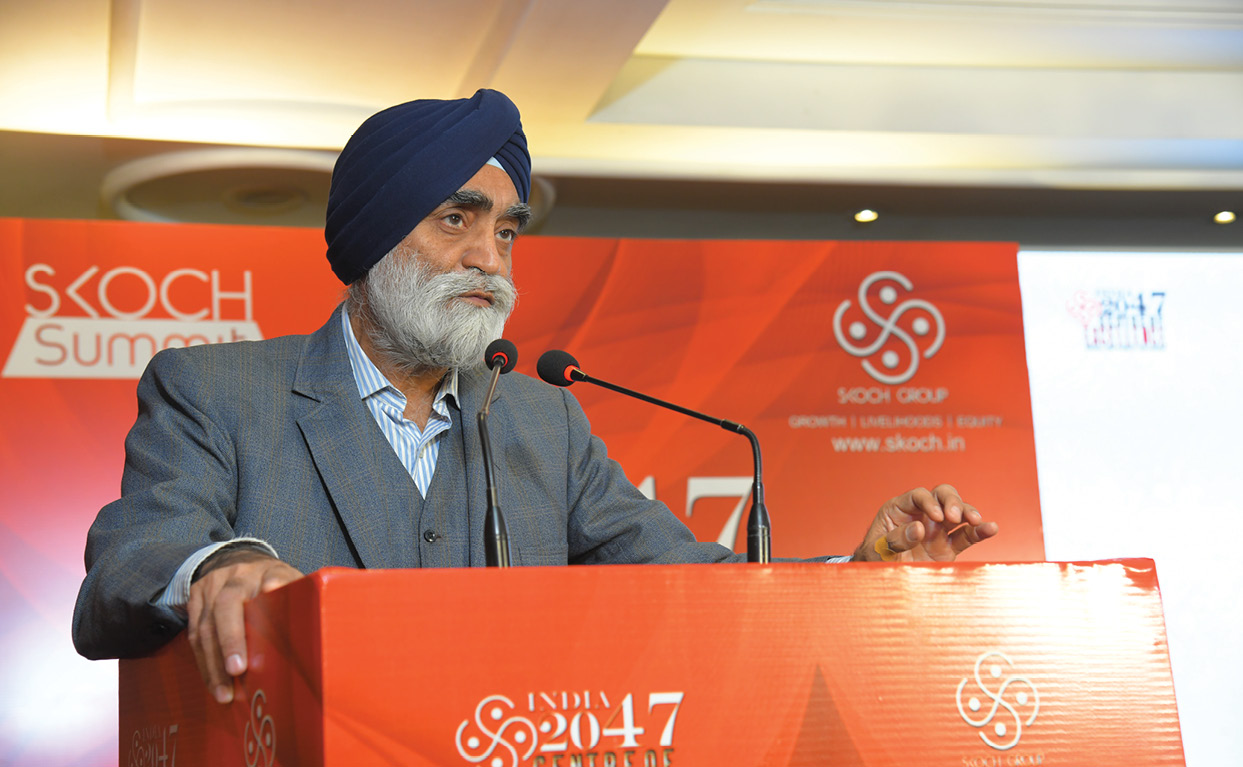
Prof Charan Singh at the 104th SKOCH Summit: Resourcing Viksit Bharat
Prof Charan Singh
Distinguished Fellow, SKOCH Development Foundation
Key Points*
- India must run faster than other nations to catch up after decades of slower growth.
- China and Korea demonstrate that sustained high growth is possible even during global turmoil.
- Structural transformation, sustainability, and stability are central to long-term development.
- Viksit Bharat should not be defined only by per capita income.
- Inclusion, zero poverty, healthcare, education, skills, and women’s workforce participation must be monitored.
- India lacks clear annual milestones and a Gantt-style roadmap toward 2047.
- States are not aligned on a common Viksit Bharat framework or targets.
- Institutions and regulators are not adequately preparing for the scale of a 2047 economy.
- External destabilizing forces inevitably accompany national growth.
- Financial stability frameworks must proactively account for geopolitical and external risks.
* This content is AI generated. It is suggested to read the full transcript for any furthur clarity.
Transcript
Good morning. At the outset, I would like to thank the SKOCH Group and Sameer Kochhar for inviting me to come and speak to you.
I am really impressed by the presentation made this morning. A brilliant presentation—a young man thinking so clearly about where the country should be and the way he has done the projections. He divided his projections into various scenarios and presented an analytical framework for us. There is no bias; it is arithmetic that is speaking. A brilliant presentation.
I wish that across our country we had such budding young people who are thinking about the nation, looking at scenario analysis, and presenting it with analytical rigour as to where we are heading.
Obviously, our main speaker for the day, the Chief Guest, is the Chairman of the Prime Minister’s Economic Advisory Council. We all feel privileged to have heard him speak and articulate the challenges so beautifully. There is absolutely no doubt that the rest of the world is galloping, and we have to catch up. Therefore, as he presented, we have to run faster than others now.
There are countries which were as poor or underdeveloped 80 years ago, even 70 or 50 years ago. China, till 1978, was just like us. As was mentioned, today China’s per capita income, with a similar population size, is five times that of India.
How did they achieve this? China grew at a flat 10 percent between 1980 and 2012—a period when the world was in deep turmoil. Korea, before that, grew at an average of 8 percent between 1962 and 1989, again during a time of global difficulty.
He is right. Many factors were mentioned, particularly structural transformation. Sustainability and stability were also highlighted. As a country rich in demographics, MSMEs play an important role, and that was rightly emphasized.
In a nutshell, this morning we have heard an excellent viewpoint from a young economist with analytical rigour and from the Chairman of the Prime Minister’s Economic Advisory Council, giving us a clear picture of where the country is and where it should be heading.
I would like to add a few points of my own and will not take more than two or three minutes.
First, congratulations on this journey of 104 summits on Viksit Bharat. I have been associated with your journey for a long time and remember your early books, including your work on financial inclusion, to which I contributed a chapter. Your journey has been remarkable.
When we speak of inclusive Bharat and inclusive growth, there are certain issues we must keep in mind. Microfinance institutions have done commendable work, as mentioned earlier.
As we embark on Viksit Bharat, I want to flag three points.
First, what is the definition of Viksit Bharat? For a long time, I pursued per capita income as the definition. Dr. Mahendra Dev rightly corrected me—should it only be per capita income? The global yardstick is per capita income, and we cannot shift goalposts for our convenience. However, it is time to think beyond that. Financial inclusion and equitable growth must be core components of our definition, and they must be monitored.
In the Finance Minister’s budget speech last year, the definition of Viksit Bharat was clearly articulated: zero poverty, 100 percent education, excellent healthcare, skilled employment, and 70 percent female labour force participation.
In any corporate sector, such targets would be monitored through a Gantt chart with annual milestones. I do not see such a framework today. If we wait until 2046 and then realize we have missed four out of five goals, it cannot be called Viksit Bharat.
India’s definition of Viksit Bharat must go beyond per capita income. Sustainability, including climate, must be central. India worships nature—trees, water, earth, and air—yet we face severe environmental challenges. The industrial revolution brought prosperity elsewhere but also climate catastrophe. Our civilizational model shows that prosperity and sustainability can coexist.
The Prime Minister has articulated the concept of lifestyle for environment (LiFE), yet we economists are not adequately incorporating it into our frameworks. The vision has been given by the political leadership; it is our responsibility as experts to translate it into measurable, monitorable targets over the next 22 years.
Second, what is that Bharat we are talking about? Bharat includes all 140 crore people and all 28 states. Have we created monitorable, quantifiable targets for each state? Only six states have prepared such plans, and they are all in different directions. Without convergence, focus, and shared ambition, Viksit Bharat cannot be achieved.
Have institutions done this planning? Have banks, insurance companies, regulators, or industry bodies aligned themselves to a 2047 vision? Regulators must ask what kind of regulatory architecture will be needed for an economy of that scale. It takes 25 years to build senior leadership in institutions, and we have only 22 years left.
Third, and most importantly, while we work hard to maintain financial stability domestically, there will be external forces attempting to destabilize us. This is inevitable for any growing nation. Growth attracts challenges.
Nature itself teaches us this. A seed faces obstacles at every stage of growth. So do nations. Korea, China, and even the United States faced destabilizing forces during their rise.
The question is: are we prepared? While we focus on maintaining stability, are we accounting for external destabilizing forces? I have not seen sufficient public discourse on this critical challenge.
Thank you very much.