SKOCH Summit


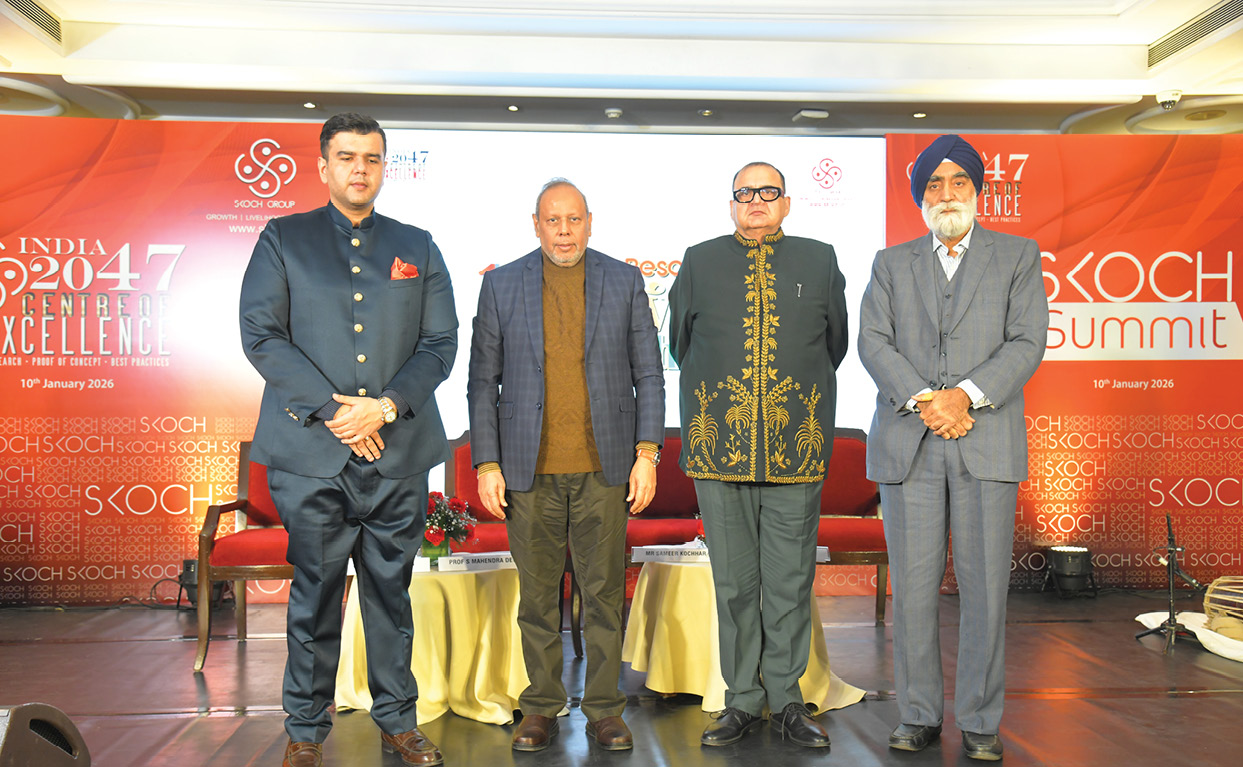
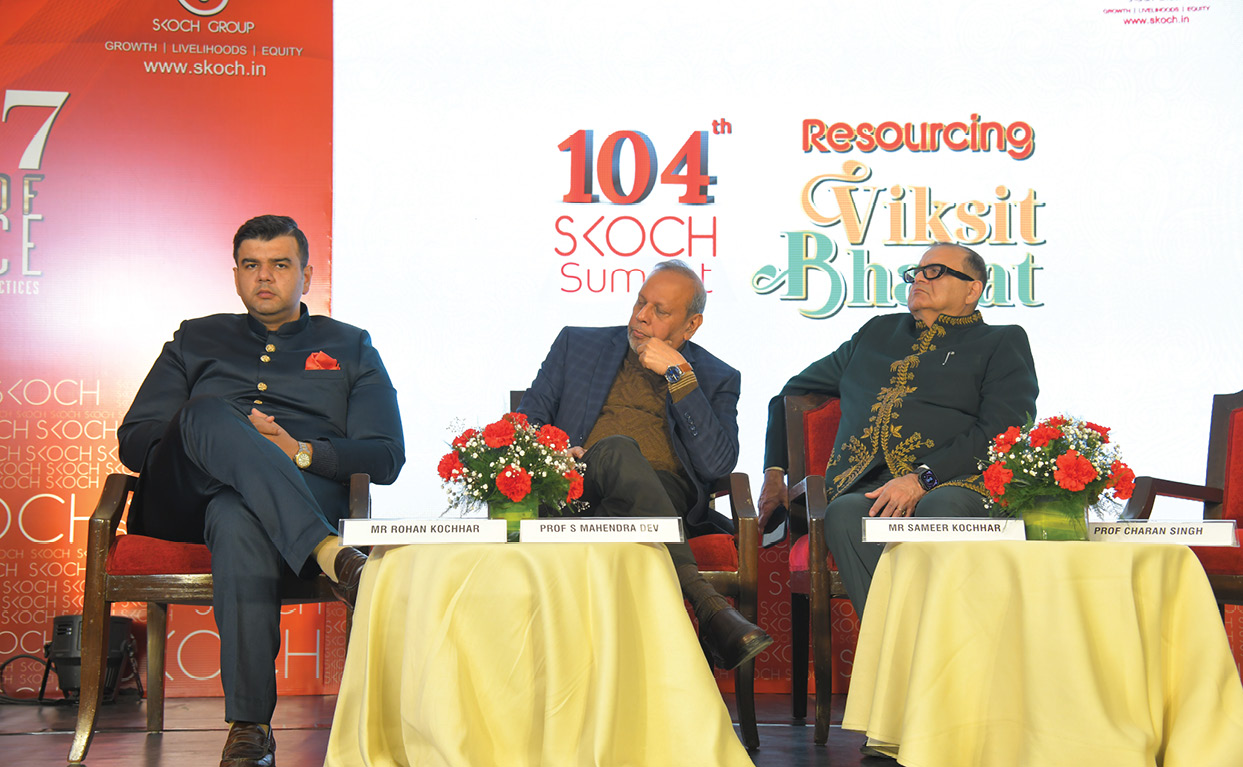




India’s journey toward Viksit Bharat 2047 must marry ambition with analytical clarity. Anchored in the Prime Minister’s vision of Amrit Kaal, this framework sets out a quantified, evidence-based pathway to a USD 20-30 trillion economy.
It links the drivers of growth - capital formation (GFCF), efficiency (ICOR) and total factor (TFP) productivity - to rising per-capita incomes through a robust macro-economic model. Central to this vision is the Tokenised Rupee Debt Instrument (TRDI), a regulated innovation that tokenises sovereign debt to deepen domestic capital markets and enhance fiscal and external resilience of additional long-term GDP growth.
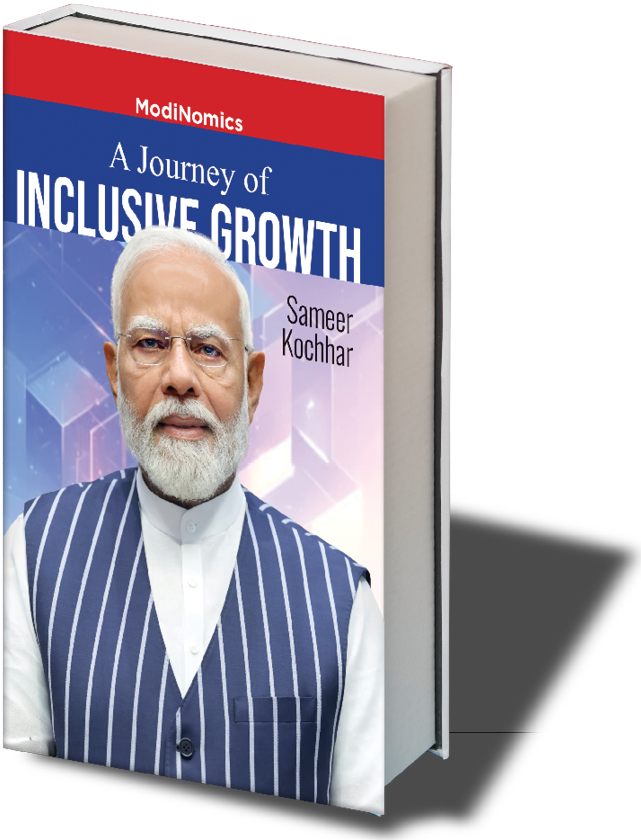
ModiNomics
A Journey of Inclusive Growth
By Sameer Kochhar, Chairman, SKOCH Group
Marking 25 years of Prime Minister Narendra Modi in public office, ModiNomics – A Journey of Inclusive Growth offers a definitive account of his governance and economic philosophy. From Jan Dhan to Ujjwala, Swachh Bharat to Digital India, it explores how millions were brought into the mainstream of development with speed and scale.
The book examines both the vision and the outcomes—financial inclusion, welfare delivery, infrastructure, and digital empowerment—that have shaped India’s transformation. It asks the vital question: has Modi delivered on the promise of inclusive growth, and how far has India travelled on this journey?
Accessible yet analytical, this is not only a chronicle of policy innovations but also a verdict on their impact. A compelling read for policymakers, scholars, business leaders, and citizens alike, ModiNomics captures India’s story of ambition, resilience, and inclusive progress under Modi’s leadership.
Arrival, Tea, Meet and Greet
Picture with Mr Sameer Kochhar, Chairman, SKOCH Group over Coffee and Refreshments
Har Ghar Tiranga
Introduction & Opening Remarks: Mr Sameer Kochhar, Chairman, SKOCH Group &
Mr Rohan Kochhar, Founder, SKOCH Law Offices
Summary: Mr Sameer Kochhar reflects on the 104 editions of the SKOCH Summit focused on building a more inclusive India. He outlines the vision of Viksit Bharat with job-generative, equitable, sustainable, and spatially dispersed growth. While India is growing at 7–8%, he notes that achieving this vision will require accelerating growth to 9–10%. This gap highlights the need for a clear national roadmap and assessment of available resources. Citing Mr. Shaktikanta Das, he underscores India’s stability amid global turmoil and the cumulative impact of reforms. He concludes by setting the stage for a discussion on the economic fundamentals needed to move from a USD 20 trillion to a USD 30 trillion economy.*
View Full Transcript
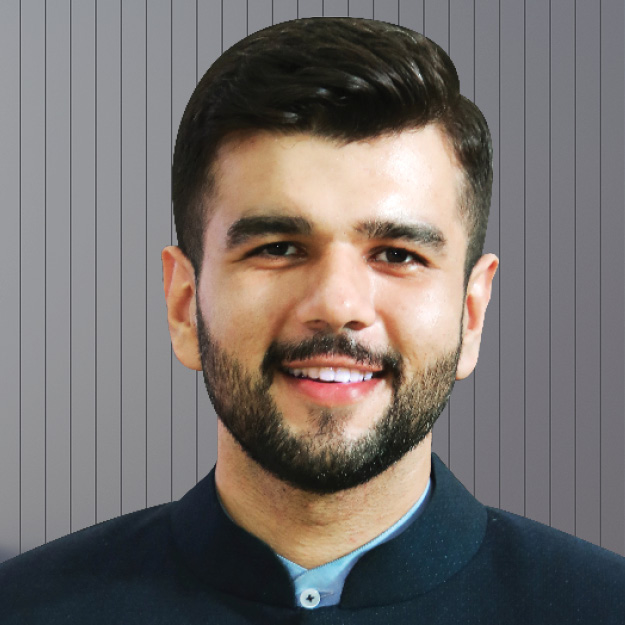
Summary: Mr Rohan Kochhar outlines a macroeconomic roadmap for achieving Viksit Bharat by 2047, targeting a USD 20–35 trillion economy. He emphasizes that the challenge is not aspiration but feasibility, driven by hard macroeconomic arithmetic. Sustainable high growth requires efficiency-led expansion through three levers: higher investment, improved capital efficiency, and stronger total factor productivity. He demonstrates that without efficiency gains, the investment required would be fiscally unsustainable. Structural reforms, productivity-enhancing technologies, and deeper domestic savings are therefore non-negotiable. The core message is that India’s path to developed economy status depends on doing more with less—making productivity the central driver of growth.*
View Full Transcript
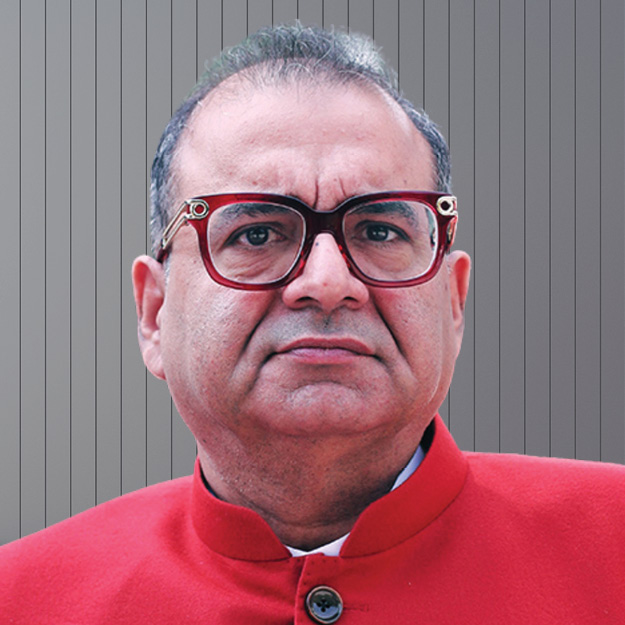
Inaugural Keynote: Prof S Mahendra Dev, Chairman, Economic Advisory Council to the Prime Minister (EAC-PM)
Summary: Prof. S. Mahendra Dev places India’s Viksit Bharat vision in historical context, explaining how delayed reforms and missed opportunities in labour-intensive manufacturing, health, and education slowed per capita income growth for decades. He argues that India must now grow faster than peers to catch up, driven primarily by higher investment and exports. While public investment has improved, a strong revival in private investment and productivity is essential. He highlights global headwinds such as protectionism and geopolitical risks, and explains India’s strategic response through diversification, trade agreements, and Atmanirbhar Bharat. Beyond growth, he stresses the importance of inclusion, sustainability, and structural transformation from agriculture to manufacturing and services. He concludes that with reforms, state-level participation, and productivity-led growth, India can avoid the middle-income trap and achieve Viksit Bharat by 2047.*
View Full Transcript
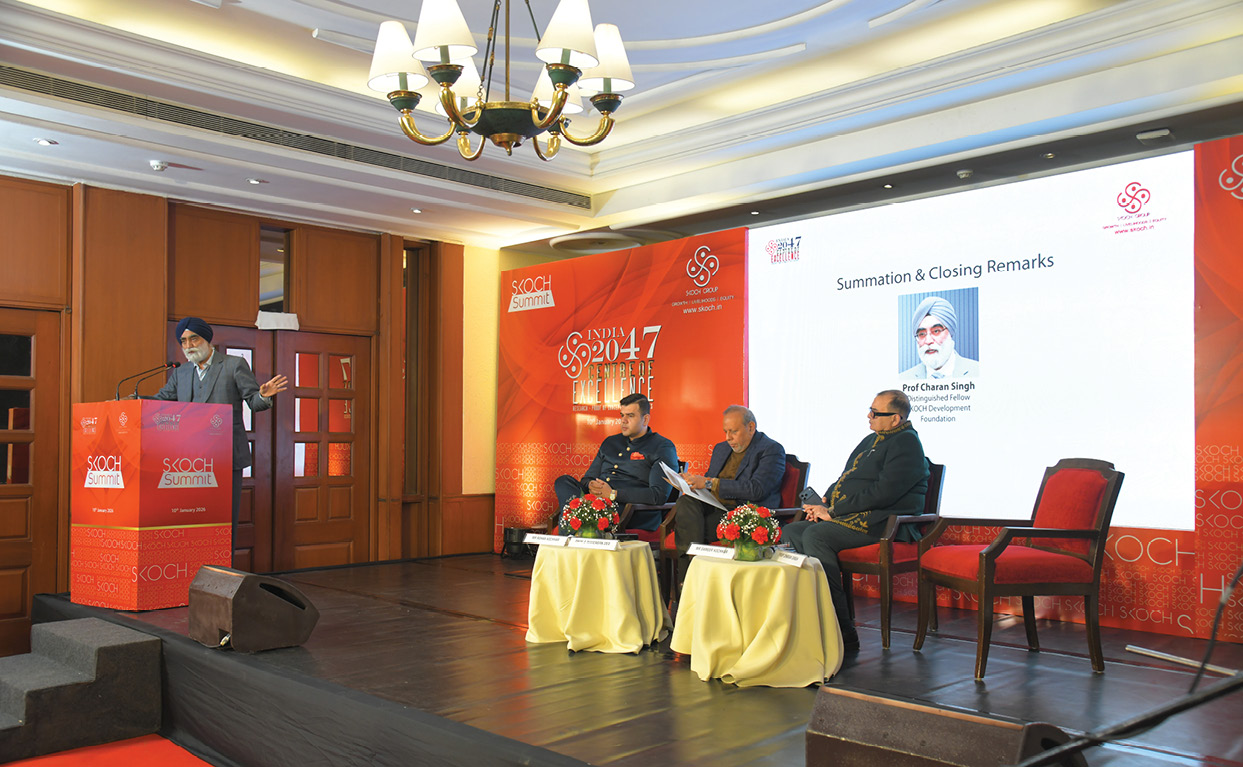
Summation & Closing Remarks: Prof Charan Singh, Distinguished Fellow, SKOCH Development Foundation
Summary: Prof. Charan Singh commends the analytical rigor of the presentations and stresses that India must grow faster than peers to catch up with countries like China and Korea that achieved sustained high growth despite global turmoil. He argues that Viksit Bharat cannot be defined by per capita income alone and must include inclusion, sustainability, and climate responsibility. He highlights the absence of clear, monitorable milestones and state-wise alignment toward the 2047 vision. Institutions and regulators, he warns, are not yet preparing for the scale of the future economy. Finally, he cautions that as India grows, external destabilizing forces will intensify, and financial stability frameworks must anticipate these challenges.*
View Full Transcript
Bandish & Beyond: SKOCH Award & Cultural Presentation
Lunch: Daawat-e-Awadh
Mr Sameer Kochhar
Chairman, SKOCH Group
Reforms historian and author of best-seller ModiNomics, Sameer Kochhar is Chairman, SKOCH Group. He is a passionate advocate of social, digital and financial inclusion and is a foremost expert on governance and inclusive growth. His work has been acclaimed globally and endorsed by Mr Narendra Modi, Mr M Venkaiah Naidu, Dr Manmohan Singh, Mr Arun Jaitley, Mr P Chidambaram, Mr Yashwant Sinha, Dr C Rangarajan and Dr Montek Singh Ahluwalia and so on. In his thinking and writings and activities, his profound admiration for India's economic reforms and in extension, those outstanding personalities who strive to make these reforms more meaningful and broad-based comes out clear and unambiguous.
View MoreProf S Mahendra Dev
Chairman, Economic Advisory Council to the Prime Minister (EAC-PM)
He served as Director and Vice Chancellor of IGIDR, Mumbai (2010–2022) and earlier chaired the Commission for Agricultural Costs and Prices. He was Vice Chairman of IFPRI’s Board, a member of the National Statistical Commission, and Director of CESS, Hyderabad. He has 150 publications, 23 books, and has advised global agencies and Indian government committees. He has received several awards, including the Malcolm Adisesaiah Award.
View MoreMr Rohan Kochhar
Founder, SKOCH Law Offices
Rohan Kochhar stands at the intersection of economics, social science, and law, leveraging his multidisciplinary expertise to drive impactful change in public policy, emerging technologies, and ESG (Environmental, Social, and Governance) initiatives. As the founder of SKOCH Law Offices, Rohan has built a boutique law firm renowned for its deep domain knowledge and innovative approach to legal challenges.
View MoreProf Charan Singh
Distinguished Fellow, SKOCH Development Foundation
Prof (Dr.) Charan Singh is Distinguished Fellow, SKOCH Development Foundation. He is CEO and Founder Director, EGROW Foundation. He was Non-Executive Chairman of Punjab & Sind Bank. Earlier and was the RBI Chair Professor of Economics at the Indian Institute of Management Bangalore, India; Senior Economist at the IMF, Washington DC; and Research Director (Economic Policy, Debt Management) at the RBI.
View More* This summary content is AI generated. It is suggested to read the full transcript for any furthur clarity.