SKOCH Summit
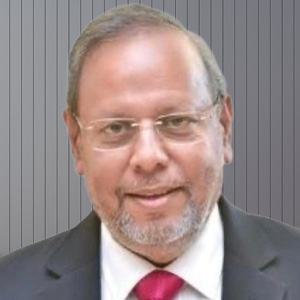
Prof S Mahendra Dev
Chairman, Economic Advisory Council to the Prime Minister (EAC-PM)
He served as Director and Vice Chancellor of IGIDR, Mumbai (2010–2022) and earlier chaired the Commission for Agricultural Costs and Prices. He was Vice Chairman of IFPRI’s Board, a member of the National Statistical Commission, and Director of CESS, Hyderabad. He has 150 publications, 23 books, and has advised global agencies and Indian government committees. He has received several awards, including the Malcolm Adisesaiah Award.
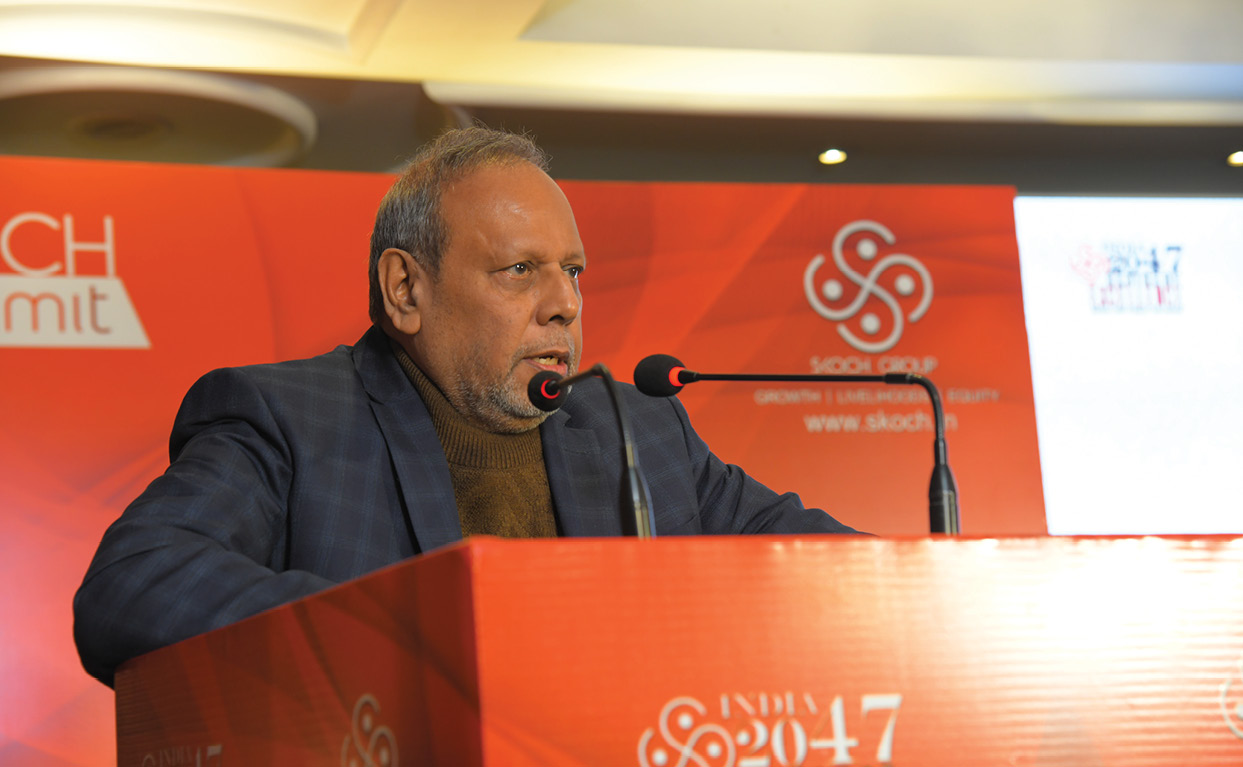
Prof S Mahendra Dev at the 104th SKOCH Summit: Resourcing Viksit Bharat
Prof S Mahendra Dev
Chairman, Economic Advisory Council to the Prime Minister (EAC-PM)
Key Points*
- India’s share of world GDP declined sharply after the Industrial Revolution due to delayed industrialisation and reforms.
- Missed focus on labour-intensive manufacturing, health, and education slowed per capita income growth post-independence.
- India lost nearly four decades with only ~1% per capita income growth, requiring faster growth now to catch up.
- Achieving Viksit Bharat requires sustained 7–8% growth supported by higher investment and exports.
- Private investment must rise significantly to reach an investment rate of 35–38% of GDP.
- Capital accounts for most growth so far, while total factor productivity remains low and must improve.
- Global headwinds include geopolitics, protectionism, and weakened multilateral institutions.
- India’s response includes export diversification, FTAs, and Atmanirbhar Bharat without reversing liberalisation.
- Structural transformation from agriculture to manufacturing and services is critical for employment and growth.
- Inclusive growth, sustainability, and avoiding the middle-income trap are central to achieving Viksit Bharat by 2047.
* This content is AI generated. It is suggested to read the full transcript for any furthur clarity.
Transcript
Good morning. Let me first compliment the SKOCH Group for this 104th Summit. These summits include a lot of policy discussions, particularly on inclusive growth, and also awards to encourage states and many other stakeholders. They are very valuable summits.
Coming to Viksit Bharat and the presentation made earlier, I think it captured all the important aspects: the resources needed, efficiency, productivity, and more. I will start by putting this in context and begin with history.
If you go back to 1700 or even 1000, India’s share in world GDP was around 25 percent. Japan, Germany, and other countries had shares of 1 to 2 percent, and the US had only 0.1 percent. After the Industrial Revolution, the share of Britain and other countries increased. During British rule, India’s share declined to about 9 percent. At the time of independence, it was only about 5 percent.
At independence, most countries followed socialist ideas. We did not concentrate on labour-intensive manufacturing, nor did we focus sufficiently on health and education in the initial decades. East Asian countries began liberalisation in the late 1970s, and South Korea even earlier in the 1960s. India started reforms only in 1991.
We therefore lost two opportunities. First, at independence, when we could have focused more on labour-intensive manufacturing and health and education. Second, we lagged liberalisation by about 15 years. As a result, the growth rate remained around 3.5 percent for nearly four decades, and per capita income growth was only about 1 percent.
People often ask why, despite being the fourth-largest economy, our per capita income remains low. The reason is that we lost four decades with only 1 percent per capita income growth. Otherwise, by now, we would have become a middle-income country, and achieving Viksit Bharat with 4–5 percent growth would have been much easier.
Compared to East and Southeast Asian countries, including China, which has nearly five times our per capita income, we started much later with reforms. That is why we must run faster now.
What policies are needed to achieve this? Some have already been mentioned, particularly resources. There are two key growth engines: investment and exports. India’s investment rate is currently around 30–31 percent of GDP, and this needs to increase to around 35 percent or more, depending on the growth target.
The Economic Survey suggests that 8 percent growth is required to achieve developed-economy status. There are two benchmarks: NITI Aayog suggests a per capita income of USD 18,000, while others argue USD 14,000 may suffice. Therefore, 7–8 percent growth could be adequate.
To achieve this, government investment through budgets and capital formation is important, but private capital must increase significantly. Private investment’s share has declined in recent years, and without its revival, we cannot reach an investment rate of 35–38 percent.
Recently, private investment has begun to pick up. Corporate cash balances are strong. Many industrialists cite global uncertainty, but uncertainty is always present. Fortunately, investment momentum has improved. CMIE data shows nearly ₹25 lakh crore of investments in the last several months. States are also attracting investment, including major projects in Andhra Pradesh and other regions. Foreign investment may also increase in the next one or two years.
A study by Chetan Ghate for the EAC-PM using KLEMS data from 1981 to 2019–20 shows that capital contributed 65 percent to growth, labour about 31 percent, and total factor productivity only 3.6 percent. This highlights the need to focus more on technology and productivity.
There are also global headwinds: geopolitical tensions, rising protectionism through tariffs, and weakening multilateral institutions such as the WTO. The Government of India is addressing these through a fourfold approach: supporting affected industries and MSMEs, diversifying export markets, accelerating free trade agreements, and continuing dialogue with major partners like the US.
India’s exports have diversified, including at the state level. For example, seafood exports from Andhra Pradesh are being redirected to Australia. Free trade agreements are being fast-tracked, and engagement with the US remains critical due to its influence on investment sentiment.
Another important approach is Atmanirbhar Bharat. Exports account for only about 20 percent of India’s GDP, while 80 percent depends on the domestic economy. Policies must therefore focus on capital, efficiency, and productivity within the domestic market.
Other growth drivers include human capital, technology, digital infrastructure, urbanisation, and women’s workforce participation. Urbanisation could reach 40–45 percent by the 2040s. Women’s labour force participation, currently 35–40 percent, can be increased through flexible work arrangements.
Structural transformation remains crucial. Agriculture still employs 46 percent of workers but contributes only 15 percent of GDP. Manufacturing employs only 11–12 percent, with a 17 percent GDP share. Increasing manufacturing and services is essential.
Globally, industrial policies have expanded sharply. Countries now seek domestic production due to geopolitical concerns. India’s emphasis on Atmanirbhar Bharat does not mean a return to pre-1991 import substitution, but rather producing competitive, world-class goods domestically.
India has undertaken numerous reforms. 2025 has been described as a year of reforms, including GST reforms, RERA, IBC, 100 percent FDI in insurance, private participation in nuclear energy, quality control orders, and ease-of-doing-business initiatives.
Inclusive growth remains essential. Viksit Bharat has three objectives: growth, inclusion, and sustainability. Quality employment is critical for reducing inequality, along with improvements in health and education to address inequality of opportunity.
Sustainability and climate change cannot be ignored. Manufacturing must align with sustainable practices, renewable energy, and ESG standards.
In conclusion, India has progressed on many fronts. With the right allocation of resources across sectors, strong reforms, and efficiency-led growth, India can significantly increase its global economic share. The role of states, regional balance, political stability, macroeconomic stability, and a large domestic market are key strengths.
India must avoid the middle-income trap and build on its achievements to create a society and economy that is prosperous, inclusive, and pro-nature.
Thank you very much.