SKOCH Summit
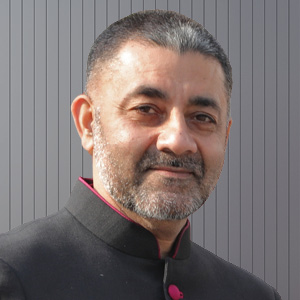
Dr Gursharan Dhanjal
Vice Chairman, SKOCH Group
Dr Gursharan Dhanjal, MA, MPhil, PhD from Delhi University and an expert in strategic affairs, is Vice Chairman, SKOCH Group. He is also the Editor of INCLUSION—a quarterly publication that focuses on development and addresses inclusive growth-related issues. INCLUSION has completed six years. He has over 20 years of work experience ranging from academics to research and business journalism to consulting. He started his career as an Assistant Professor and taught at Delhi University for five years before joining Asia Business News (India)—Dow Jones, a premier broadcaster of business and financial news during the mid-90s. He also worked for CNBC for over three years during the late 90s.
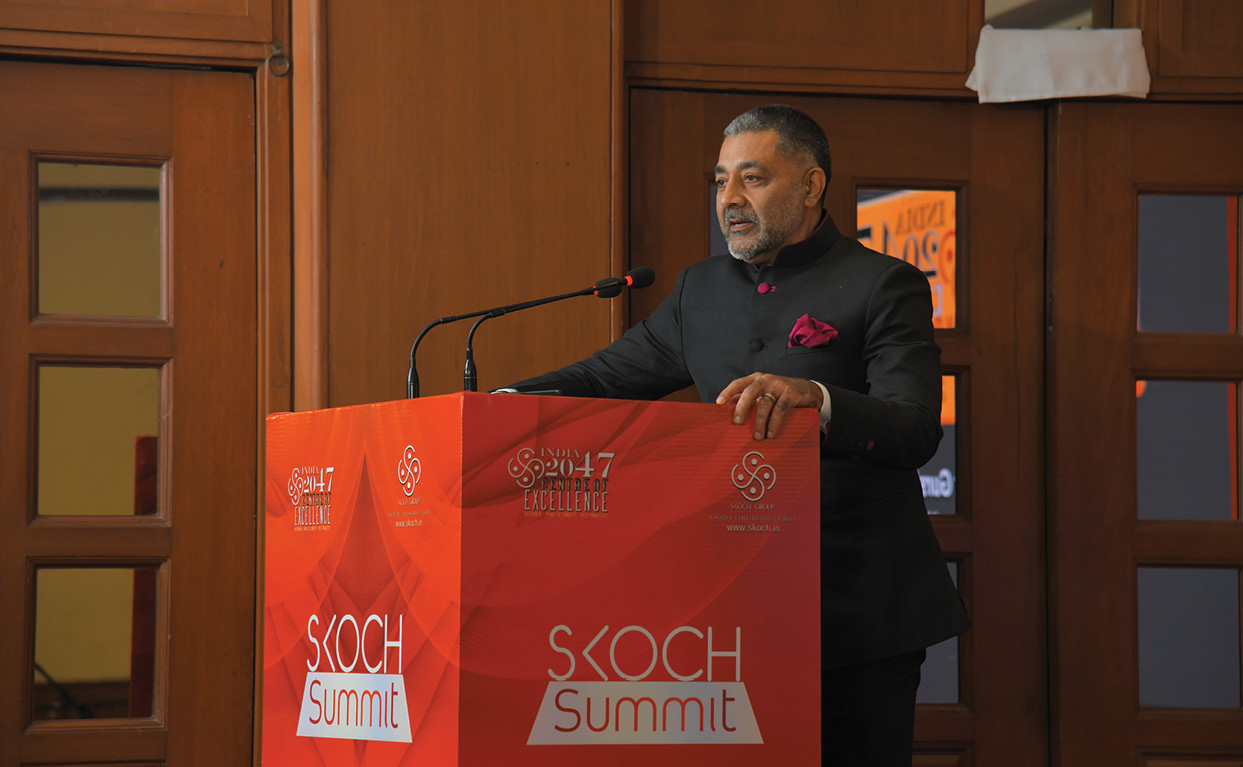
Dr Gursharan Dhanjal at the 105th SKOCH Summit: Governing Viksit Bharat
Dr Gursharan Dhanjal
Vice Chairman, SKOCH Group
Key Points*
- Governing Viksit Bharat requires knowledge-building alongside nation-building.
- Global indices often misrepresent India due to context-insensitive indicators.
- Correcting India-specific narratives significantly improves global rankings.
- Financial deepening through pensions, insurance, and credit reduces poverty.
- Small loans under schemes like MUDRA generate meaningful local employment.
- State-level governance outcomes have been tracked across 37 indicators since 2003.
- Governance priorities have shifted, with recent focus on urban services, energy, and education.
- Corporate contribution is assessed through ESG, digital transformation, and human rights frameworks.
- Indian corporates perform well on rights-based compliance but lag on mental well-being indicators.
- Evidence-based governance and continuous institutional learning are essential for achieving Viksit Bharat.
* This content is AI generated. It is suggested to read the full transcript for any furthur clarity.
Transcript
From the subject that Rohan discussed—resourcing Viksit Bharat—we now move to governing Viksit Bharat. There are various dimensions to this. At the base lies the process not only of nation-building, for which all of you are responsible, but also of knowledge-building, to which organizations such as the SKOCH Group have been contributing.
This knowledge-building is essentially based on discussions, problem-solving, and idea refinement. This, in turn, leads to the creation of scalable models, which we call best practices. Over the last three decades, this accumulated knowledge has contributed to policy course correction, as well as emulation and scale.
I will speak about a few such elements to which our accumulated knowledge has contributed.
The slide in front of you refers to the Indian narrative in global indices—from 50 percent to 500 percent, which Uncle Sam talks about in terms of tariffs. These are non-tariff barriers that India has faced for many years. The voice of the Global South has been missing in global conversations, and for the first time, the Honourable Prime Minister, Mr. Narendra Modi, at international forums, emphasized that India must lead the voice of the Global South.
We therefore undertook an exercise to present the Indian narrative across various global indices led by the United Nations, World Bank, IMF, and others. These include the e-Government Development Index, ICT Development Index, and Human Development Index. As you can see, India’s rankings are extremely poor, which may not reflect reality.
We examined India-specific narratives and sought to correct them by incorporating contextual realities into the existing frameworks. For instance, in the e-Government Development Index, by correcting just three indicators, India’s rank improves significantly—from 105 out of 193.
One argument is that India is extremely poor in digital transactions. I am sure no one here would agree. India is among the highest in digital transactions. Even on the street, a beggar will flash a Paytm QR code. Second, India is said to be poor in broadband connectivity. We are largely wireless today and do not require wired broadband. Third, India is said to be extremely poor in digital literacy. For us, gross enrolment ratios are more relevant, and almost every child knows how to use a mobile phone and conduct digital transactions.
These corrections have led to improved rankings.
Over the last 30 years of knowledge accumulation, we were also able to present a narrative on the job-generative growth of Modinomics, which was presented during last year’s elections. The Honourable Prime Minister quoted this report on national television multiple times, which demonstrates the power of evidence-based knowledge.
We also examined financial deepening—how resourcing Viksit Bharat through pensions, insurance, and micro-products has progressed. There has been deep penetration, and scores between 2019–20 and 2021–22 have improved significantly. Between 2015 and 2022, the credit gap fell by 12.1 percent, a major achievement.
There is a strong correlation between access to credit and multidimensional poverty reduction. Schemes such as MUDRA have enabled small entrepreneurs to access loans. Our primary research across the country shows that loans as small as ₹80,000 have generated multiple employment opportunities at the local level.
This leads to what we call the State of Governance assessment, based on primary research and outcomes. While the 2025 results are being prepared, findings from 2024 show Maharashtra, Gujarat, and Andhra Pradesh as the top three states. States are ranked across 37 governance indicators, covering sectors from agriculture to forests.
This data is available not only for 2024 but also historically, going back to 2002–03. This allows us to track how governance priorities have shifted over time. For example, agriculture may have been a priority in one state earlier and improved in another later.
In 2024, focus areas included municipal governance, power and energy, general administration, transport, and education. Tribal welfare, unfortunately, ranked lowest. Revenue, tourism, infrastructure, housing, and culture remained stable focus areas, with a noticeable revival of cultural initiatives.
Areas with reduced governance focus included irrigation, geology and mining, disaster management, minority affairs, animal husbandry, and fisheries.
The Governance Outcome Index has been conducted since 2003, with a well-established methodology. As part of the SKOCH 2047 Centre of Excellence, we have also worked on the e-Governance Infrastructure Index to understand why India fares poorly on global indices.
We developed a Financial Prudence Index to assess outcome-based budgeting at the state level. States have begun focusing more on outcomes rather than just expenditure. We also assessed government transformation by region, finding that western states lead in governance efficiency, followed by the east, while development outcomes are strongest in the west and north.
Moving to another dimension—India Inc.—we assessed how corporates are contributing to Viksit Bharat. We developed a governance framework covering ESG, digital transformation, corporate digital responsibility, and human rights in business.
Over 1,200 indicators are used to assess corporates, similar to the framework used for states. In 2024, the top 50 Indian corporates were identified as “India Involved,” performing well across governance, ESG, digital transformation, and human rights.
Our human rights framework covers policies, labour rights, and mental well-being. Mental well-being is particularly critical. Incidents of extreme workplace stress, including suicides and the pressures faced by gig and delivery workers, highlight the need to protect employee rights.
We compared India’s top Nifty 50 companies with the top 20 Fortune 500 companies. Indian firms performed better on rights-based indicators and compliance quality, while global firms performed better on mental well-being indicators, indicating an area where India must catch up.
We also examined corporate intervention priorities. Digital transformation tops the agenda, followed by corporate and social excellence. Governance excellence, in ESG terms, remains the lowest priority. Environmental focus declined from 24 percent in 2023 to 13 percent in 2024, reflecting transitional pressures.
ESG adoption has largely been limited to top corporates but is now expanding to a broader universe under BRSR reporting, which is based on global standards such as GRI. India does not yet have its own indigenous ESG standards.
Through the SKOCH 2047 Centre of Excellence, this research has been used to guide corporates and governments on best practices and benchmarks. These assessments are qualitative, participative, and based on organizations that voluntarily share their practices.
For the sake of time, I will conclude here. I would be happy to answer any questions offline or online, and all reports are available on our website at https://coe.skoch.org or https://skoch.in
Thank you very much for your patience.
Jai Hind.