SKOCH Summit

Mr Rohan Kochhar
Founder, SKOCH Law Offices
Rohan Kochhar stands at the intersection of economics, social science, and law, leveraging his multidisciplinary expertise to drive impactful change in public policy, emerging technologies, and ESG (Environmental, Social, and Governance) initiatives. As the founder of SKOCH Law Offices, Rohan has built a boutique law firm renowned for its deep domain knowledge and innovative approach to legal challenges.
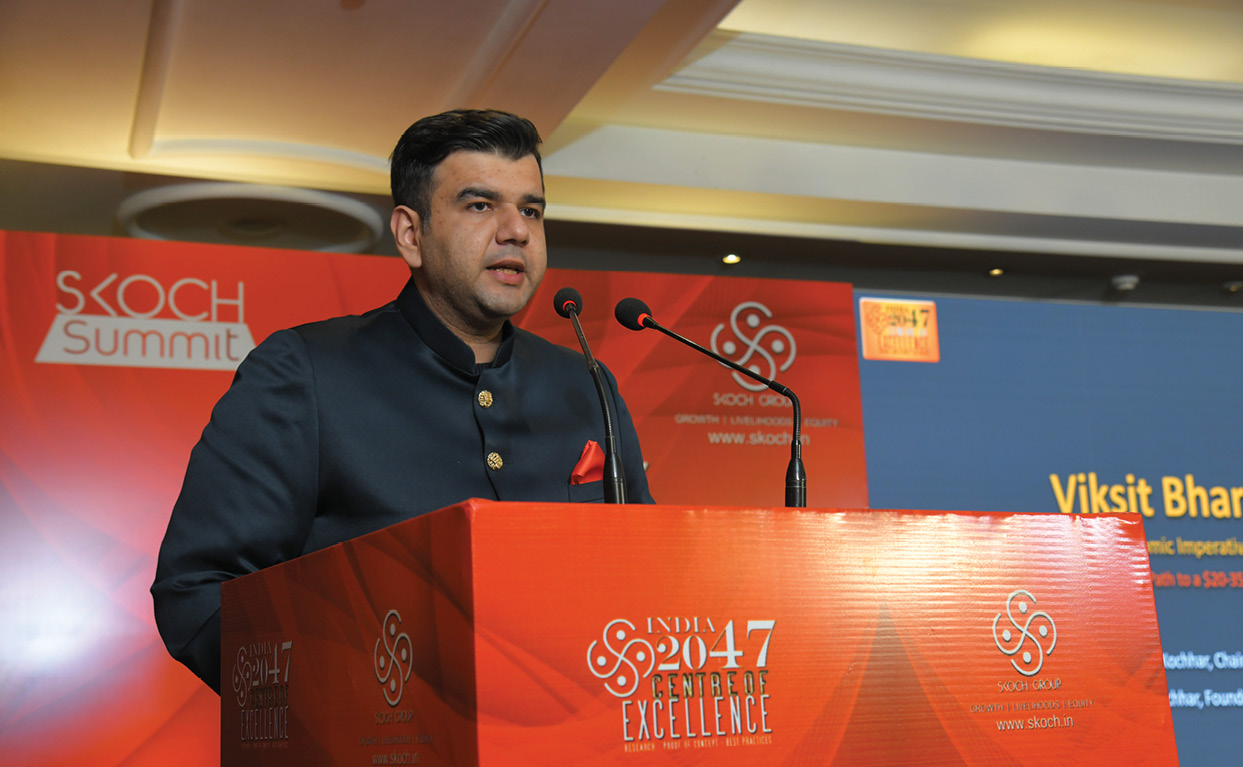
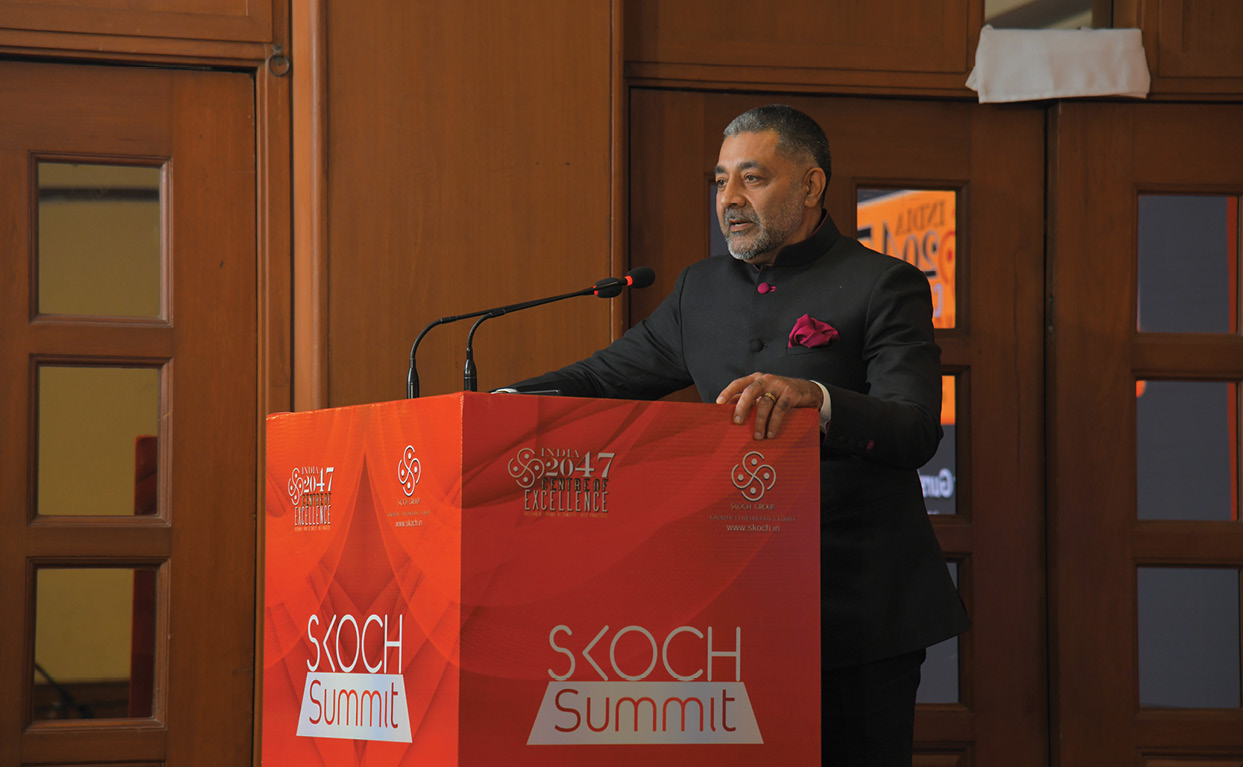
Mr Rohan Kochhar at the 105th SKOCH Summit: Governing Viksit Bharat
Mr Rohan Kochhar
Founder, SKOCH Law Offices
Key Points*
- India aims to become a developed, high-income economy by 2047 with GDP of USD 20–35 trillion.
- Achieving this requires sustained growth of 7.5–10%, depending on ambition level.
- Growth depends on three levers: capital accumulation, capital efficiency (ICOR), and total factor productivity (TFP).
- India’s current ICOR of around 4 must fall below 3.5 to make higher growth feasible.
- Investment rates above 40% of GDP are unsustainable without efficiency improvements.
- Productivity-driven growth is essential due to diminishing returns to capital.
- Domestic savings must rise from ~30% of GDP to the mid-30s to finance growth safely.
- Structural reforms in taxation, labour, infrastructure, and digital systems are critical productivity drivers.
- Financial innovations such as Tokenised Rupee Debt Instruments can improve capital efficiency.
- Viksit Bharat 2047 is achievable only through efficiency-led growth, not brute-force investment expansion.
* This content is AI generated. It is suggested to read the full transcript for any furthur clarity.
Transcript
Good afternoon, and a very warm welcome to the 105th SKOCH Summit.
Just this morning, during the 104th SKOCH Summit, the day was graced by the presence of two of India’s leading economists, Professor Charan Singh and Professor S. Mahendra Dev, who is also the Chairman of the Economic Advisory Council to the Prime Minister of India. The theme under discussion was Viksit Bharat: India 2047 — the Roadmap to a 20–35 Trillion Dollar Economy, focusing on macroeconomic imperatives for development.
One of the things Professor Charan Singh said to us over tea was, “Don’t shy away from Viksit Bharat. Give us a game plan.” It is in that spirit that I am very pleased to reintroduce to you, during the 105th SKOCH Summit, *Macroeconomic Imperatives for Viksit Bharat 2047: India’s Path to a 20–35 Trillion Dollar Economy*.
My purpose today is not to restate aspiration, but to examine macroeconomic feasibility through hard arithmetic and the structural conditions under which India can credibly achieve developed economy status by the centenary of independence.
I will proceed in six steps.
First, the 2047 vision and scale.
Second, a three-lever growth framework grounded in economic growth theory, namely the Harrod–Domar and Solow growth models.
Third, GDP scenarios and investment arithmetic.
Fourth, India’s capital formation and savings constraints.
Fifth, structural reforms and productivity drivers.
And finally, policy imperatives, including a financial architecture for innovation.
India’s stated objective is to become a fully developed, high-income nation by 2047. In GDP terms, this implies a target range of 20–35 trillion dollars, from roughly 3.5–3.7 trillion dollars today. This represents an expansion of 5.4–9.5 times.
At a 30 trillion dollar economy, per capita income rises from about 2,800 dollars today to roughly 18,000 dollars, a six- to seven-fold increase. This scale tells us immediately that the challenge is not intent, but macro arithmetic.
There are three main macroeconomic levers to which growth theory reduces the problem.
The first is capital formation. India’s gross fixed capital formation today is 30–32 percent of GDP. The ambition implies that it should lie somewhere in the 35–40 percent range.
The second is capital efficiency, captured by the incremental capital–output ratio, or ICOR. India’s ICOR is currently between 4 and 5. The target must be below 3.5.
The third is total factor productivity—growth beyond capital and labour, driven by technology, skills, institutions, and governance. All three must move together, as no single lever suffices.
ICOR measures how much additional investment is required to generate one unit of GDP. If ICOR is 4, we invest four rupees to produce one rupee of output. If ICOR is 3, we invest three rupees. Developed economies operate around an ICOR of 3. India averaged 5 in the 2010s and today, by some estimates, is nearer to 4. Every reduction in ICOR directly lowers the growth financing burden.
Total factor productivity captures efficiency gains from technology, innovation, skills, institutions, and management quality. The insight from the Solow growth model is critical: capital has diminishing returns, and sustained per capita income growth must therefore come from productivity.
India’s post-1991 liberalisation significantly boosted total factor productivity. Future growth must rely even more heavily on this channel.
The core hypothesis, therefore, is efficiency-driven growth. A brute-force strategy is unsustainable. Investment rates of 40–50 percent of GDP cannot be achieved through brute force alone. The viable path is doing more with less—lower ICOR and higher total factor productivity. Efficiency improvements are essential, not optional.
We present four modelled GDP scenarios for 2047: a modest scenario, a baseline scenario, a vision scenario, and an ambitious scenario, corresponding respectively to middle-income, high-income, developed, and advanced economy status.
Across these models, GDP increases in increments of 5 trillion dollars, from 20 to 25 to 30 to 35 trillion dollars, all at market exchange rates. The required compound annual growth rate increases in increments of 0.5 percent across models, ranging from 7.5–8 percent in the modest scenario to 10 percent in the ambitious scenario.
As Professor Charan Singh rightly said this morning, a 2 percent gap can set you back 25 years. We therefore adopt modest 0.5 percent increments.
Per capita income rises in increments of 3,000 dollars, from 12,000 to 21,000 dollars across scenarios. Required investment rates, as a percentage of GDP, increase by roughly two percentage points across scenarios, from 33–35 percent to over 40 percent, assuming improvements in ICOR and total factor productivity.
The lower scenarios are feasible under current efficiency conditions. Higher scenarios require structural efficiency gains.
Here is the hard arithmetic. With current efficiency, an ICOR between 4 and 5, a 20 trillion dollar GDP requires a 33 percent investment rate, while a 30 trillion dollar GDP requires 42–45 percent investment. With improved efficiency and ICOR below 3.5, a 25 trillion dollar GDP requires 36 percent investment, and a 30 trillion dollar GDP requires 40 percent.
The hurdle is that the vision scenario of a 30 trillion dollar economy requires 9.5 percent growth. Without efficiency gains, this demands an investment rate of 42–45 percent of GDP, which is historically rare and fiscally difficult. Efficiency is therefore non-negotiable.
India’s gross fixed capital formation currently stands at 32 percent of GDP, the highest in a decade, yet still 3–8 percentage points below targets. Private investment announcements are up 39 percent year-on-year, with the private sector accounting for 70 percent of new projects. Government capex as a percentage of the budget is also at a ten-year high.
Domestic savings, at about 30 percent of GDP, must rise to at least the mid-30s. External commercial borrowings at 1.2 percent of GDP are supplemental and cannot substitute for domestic savings.
The macro identity is simple: investment of 32–40 percent must equal domestic savings plus external flows. Today, domestic savings plus external borrowings barely cover current investment. Higher growth requires significantly higher domestic savings to avoid external debt traps.
Household financial savings have declined to around 5–5.3 percent of GDP, even as physical savings remain strong. External commercial borrowings stand at about 190 billion dollars, roughly 5 percent of GDP. FY25 registrations are 34 billion dollars, with nearly 50 percent used for capex. External capital helps, but cannot replace deep domestic savings.
Several reforms are improving efficiency. The National Quantum Mission commits around 6,000 crore rupees through 2031. The India AI Mission allocates about 10,000 crore rupees, including over 10,000 GPUs. These initiatives aim to accelerate total factor productivity, not provide short-term stimulus.
GST has created a single internal market, reduced logistics costs, and increased formalisation, adding an estimated 1–1.5 percent to long-run GDP. The 2025 GST rationalisation focused on the 5 and 18 percent slabs with a revenue cost of around 48,000 crore rupees. The Direct Tax Code 2025 improves compliance and investment certainty. Labour laws have been consolidated into four codes, improving flexibility, apprenticeships, and formal job creation.
PM Gati Shakti has reduced logistics costs to about 8 percent of GDP. The National Monetisation Pipeline has recycled 3.85 lakh crore rupees into new infrastructure. The Jan Vishwas Act improves trust-based governance. Startup India now counts over 100 unicorns, with tax holidays extended to 2030. The Securities Markets Code Bill consolidates three statutes, reducing transaction costs and regulatory uncertainty.
Developed-economy status requires balanced regional growth. India currently faces stark interstate per capita income disparities, with some states three to five times wealthier than others.
Growth theory and evidence align. The Harrod–Domar model links growth to investment divided by ICOR. The Solow model highlights the role of productivity. East Asian economies combined 35–40 percent investment with productivity catch-up.
One innovation proposal is Tokenised Rupee Debt Instruments, or TRDI—1:1 backed digital tokens of government securities issued by regulated entities. TRDI is not a CBDC or a stablecoin. It aims to improve capital efficiency through programmable sovereign debt.
Global evidence shows tokenised bonds have tighter spreads and better liquidity. These efficiency gains compound over time, boosting productivity and lowering ICOR.
Pooling household savings into patient capital for infrastructure and productivity investments can redirect wealth from low-productivity assets toward growth-supporting financial instruments.
The four policy imperatives for Viksit Bharat 2047 are: mobilising domestic savings, improving capital efficiency, accelerating total factor productivity, and sustaining structural reforms.
The formula is simple: 33–40 percent investment, ICOR below 3.5, and productivity acceleration together form a feasible pathway. Viksit Bharat 2047 is achievable only through efficiency-led growth.
This is a marathon of productivity, not a sprint of spending.
Thank you very much. I look forward to the discussions.