SKOCH Summit

Prof Sachin Chaturvedi
Director General, Research and Information System for Developing Countries (RIS)
Professor Sachin Chaturvedi is currently Director General at the Research and Information System for Developing Countries (RIS), a New Delhi-based Think-Tank. He works on issues related to development economics, involving development finance, SDGs and South-South Cooperation, apart from trade, investment and innovation linkages with a special focus on WTO. Currently, Prof. Chaturvedi is also an Independent Director on the Board of the Reserve Bank of India.
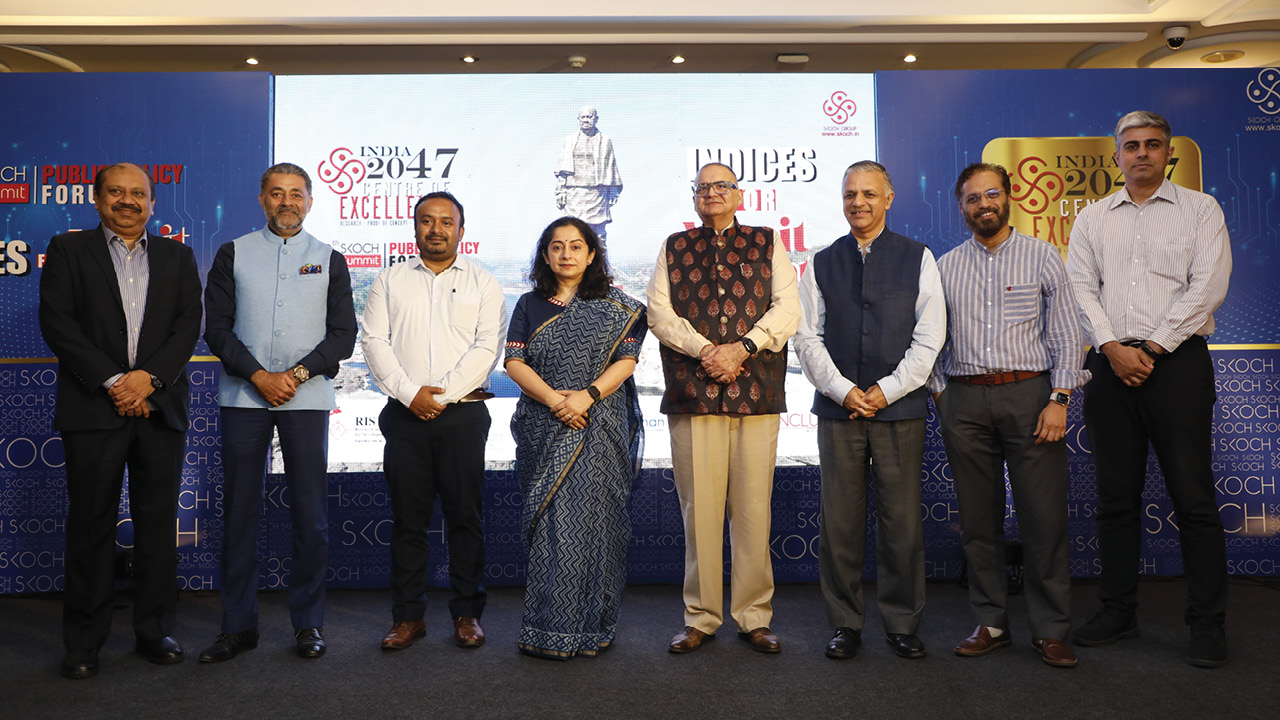
Prof Sachin Chaturvedi at the 98th SKOCH Summit: Indices for Viksit Bharat
Prof Sachin Chaturvedi
Director General, Research and Information System for Developing Countries (RIS)
Key Points*
- India must redefine development parameters to reflect the kind of growth it truly wants, not just GDP expansion.
- Growth should be inclusive, environmentally responsible, and responsive to local realities.
- The debate must move beyond GDP toward augmented and well-being–based measures of development.
- India has a leadership role at the UN Statistical Commission in shaping future global development indices.
- Statistical capacity at district and state levels is critically weak and needs urgent strengthening.
- SDGs marked a shift from quantitative targets to qualitative outcomes like nutrition, health, and sanitation.
- Basic needs and grassroots data gaps undermine effective policy and delay Viksit Bharat goals.
- Technology, innovation, and economic growth are deeply intertwined and must be measured together.
- Community participation, environment, housing quality, jobs, and work–life balance should be part of new indices.
- India needs future-oriented, ethical, and environmentally sensitive surveys to guide global and national policy.
* This content is AI generated. It is suggested to read the full transcript for any furthur clarity.
Transcript
About Indian indices for global use, and to share his views, may I please request Professor Sachin Chaturvedi, Director General, Research and Information System for Developing Countries (RIS), to kindly be on the stage. Ladies and gentlemen, he works on issues related to development economics involving development finance, SDGs, and South–South cooperation, apart from trade, investment, and innovation linkages, with a special focus on the WTO. Currently, Professor Chaturvedi is also an Independent Director on the Board of the Reserve Bank of India. We welcome you, sir, and good morning.
Good morning to everyone. It is a great pleasure to join SKOCH in this mega exercise that they have initiated, focusing on issues that are there in our development indices—the issues which India can address in terms of responding to the global narratives that are emerging, and, as Shamika just said, also trying to do the data processing that is required.
I would take a slightly different view in terms of contributing to the debate and discussion that we have initiated today. I would focus, for the next ten minutes or so, on four broad dimensions, and I will be very precise.
First and foremost is our idea of what kind of development parameters we are looking at. This is something I thought would be of great significance in terms of India’s growth performance and India’s narrative-setting. That is one part of the story in terms of how we take the development narrative forward. But the second important part is: what is it that we actually want in our development? What kind of parameters do we want to get captured in our endeavors for economic development?
As we have been hearing from the Prime Minister in terms of making growth more inclusive and more responsive, how do we do that? Is it correct that, in Ridge and many other areas of Delhi, we are seeing trees disappearing while Delhi’s GDP is expanding? Do we really want that kind of growth? Do we really want that kind of development? So what parameters are we thinking of, and what parameters are we ending up with?
Then there are two more issues. One is at the global level: India is part of the UN Statistical Commission. What role do we play in terms of transition of statistics at the global level, as part of the leadership of the UN Statistical Commission? The fourth and last issue—which very often does not appear in our statistical debates—is about the plight of statistical institutions at the bottom, at the district level and at the state level.
How many states have a statistical commission? Anyone has any guess? We need to have these institutions, which are currently not responding adequately in terms of how we localize our development strategies. This is extremely important as we go forward. At this point, in the country, only two states have statistical commissions. Kerala has one, but no members currently, and the one member earlier was only part-time. Madhya Pradesh is the only state which has, last year, created a statistical commission and has a full-fledged team trying to do calculations needed at the grassroots level.
I will now quickly go through these four points.
During the G20 presidency, the Prime Minister made a statement—not only before the G20 meeting but also in his inaugural remarks—that we need to go beyond GDP. GDP, as an economist came up with the idea of how growth is captured and what kind of measurements we can do. This is important for us: how do we take the debate beyond GDP?
The United Nations Secretary-General has already initiated a major exercise in terms of defining how we look at GDP and what dimensions we can augment to enrich our understanding. This dimension is important. Again, in September, when the Future Summit is coming up, the Prime Minister is going to raise issues related to augmented GDP. What is that augmented GDP, and what kind of work can we do?
At my own institute, RIS, we have a team working on these dimensions—bringing in the historical debate on GDP. RIS, back in 1984, contributed a major concept on how we can bring in transition in GDP measurement. Our idea was that after the GDP framework was globally adopted, we should move towards capturing basic needs. We tried that approach at that time.
When the Human Development Index by Mahbub ul Haq and Amartya Sen was adopted, as Sameer mentioned earlier, the statistical mechanisms at the global level were, in a way, under siege by people with specific inclinations. That is something we need to challenge and replace with ideas that are more inclusive and responsive to realities.
We did not adequately measure whether people’s basic needs were being met at the grassroots level. During COVID, we had no idea how many units in a particular district were shut down. What happened to people who had not borrowed from banks? Since I sit on the RBI Board, every time we discussed MSMEs and borrowings, we realized that while special packages were announced, district-level data from state industry departments was simply not available.
Similarly, data on hospitals, beds, and other essential infrastructure was missing. The Millennium Development Goals, adopted in 2000, attempted to capture some of this, but they fell short. We then moved to SDGs in 2015.
What is the difference between MDGs and SDGs? I could take two hours to explain, but let me summarize. The most important shift is from quantity to quality. Earlier, we focused on quantitative indicators—enrollment, food security. SDGs emphasize qualitative indicators like nutritional security, which requires water, sanitation, health services, and gender participation.
That shift in development philosophy is crucial. Basic needs that were overlooked earlier must now be revisited. If we want to achieve Viksit Bharat by 2047, fundamental grassroots challenges must be addressed—not only education, health, fuel, water, and sanitation, but also basic statistics.
We need to know which districts are aspirational or non-aspirational, how parameters change year to year. Floods derail development efforts every year—do we have statistical measurement of this? If Viksit Bharat is to be realized, these statistical gaps must be filled.
During the BRICS presidency in 2016, RIS suggested a Wellness Index to bring coherence across development indicators. Similarly, if Brazil’s G20 presidency talks about protecting the Amazon, the idea is clear—GDP growth at the cost of forests is not acceptable.
Technology and economics are deeply intertwined. I have worked for nearly 30 years on technology–economics linkages. Innovation shapes trade, exports, and competitiveness. If economists do not understand technology, countries pay a price. I demonstrated in my PhD how Singapore lost its ICT edge and later recovered through a bio-pharma strategy, which today contributes significantly to manufacturing growth.
In 2019, when India and Japan announced STI for SDGs, RIS evolved new indices showing how science, technology, and innovation contribute to sustainable development through access, equity, and inclusion.
During India’s G20 presidency, multidimensional frameworks for well-being were discussed. If Viksit Bharat is to move forward, indicators must capture biodiversity, environmental protection, housing affordability, quality of jobs, income stability, and community participation.
Community played a huge role during COVID, yet our statistical framework has no space for community. If we want to incentivize community participation, we must first measure it.
Education quality, environment, health, life satisfaction, lifestyle for environment, and work–life balance must be part of our framework. India faces a dual challenge—some people struggle with work–life balance, while others are still searching for work. Our statistical systems must address this duality.
At RIS, we work with the Ministry of External Affairs on India’s future—international engagement, financial dimensions, ethics, and technology. With AI, synthetic biology, and converging technologies, we must revisit science and technology indicators.
We are working with the Department of Science and Technology to align innovation indicators with inclusive economic progress, regional equity, and GDP expansion. AI, nanotechnology, biotech, and ICT convergence can significantly accelerate growth, but we must measure it properly.
Similarly, the blue economy is not just fisheries—it includes insurance, reinsurance, shipbuilding, and new sectors. India must improve survey quality, develop alternative and future-oriented surveys, without compromising environmental and ethical concerns.
Sameer, thank you very much for inviting me. I will stop here. Thank you.