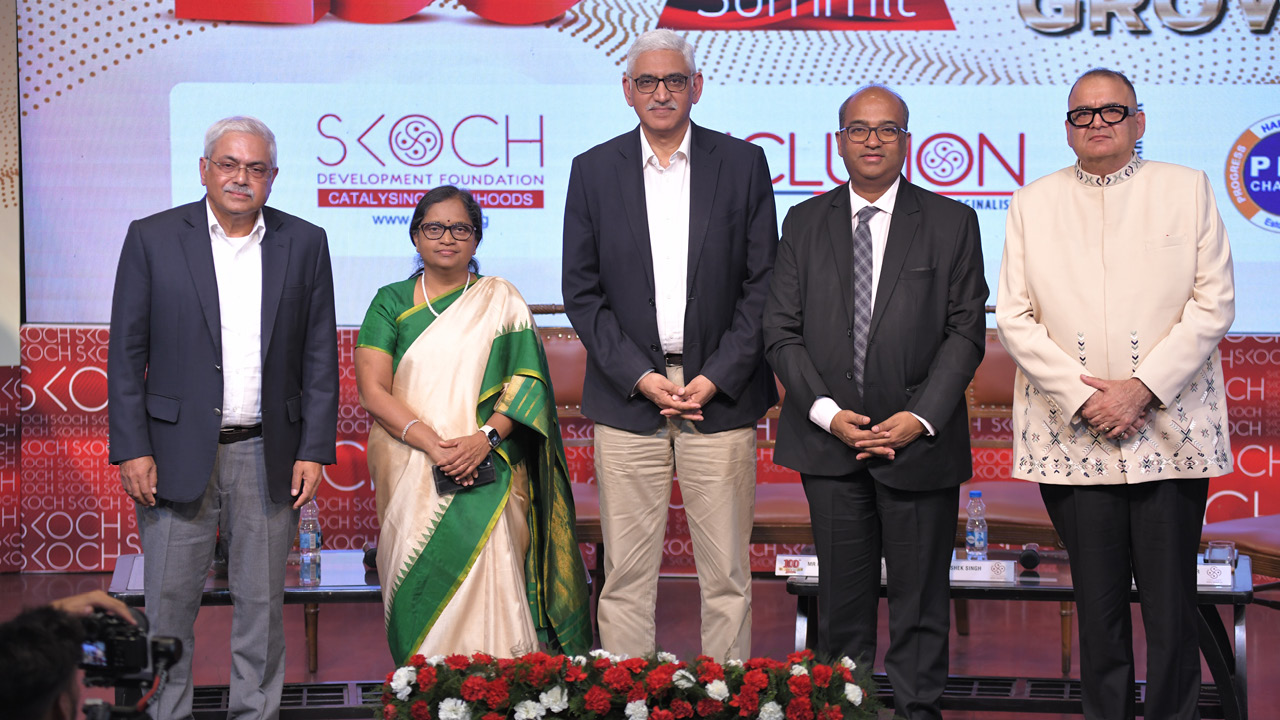
SKOCH Summit
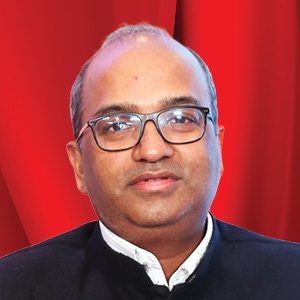
Mr Abhishek Singh
Additional Secretary, Ministry of Electronics and Information Technology (MeitY)
Mr Abhishek Singh at the 100th SKOCH Summit: New Dimensions in Inclusive Growth
Mr Abhishek Singh
Additional Secretary, Ministry of Electronics and Information Technology (MeitY)
Key Points*
- SKOCH has played a pioneering role for two decades in advancing digital governance and public policy in India.
- India’s global leadership in IT services laid the foundation for Digital India and digital public infrastructure.
- Aadhaar created a universal digital identity enabling inclusion, financial access, and efficient service delivery.
- Direct Benefit Transfers powered by Aadhaar and Jan Dhan have eliminated leakages and saved billions.
- UPI transformed digital payments, improving efficiency for citizens and strengthening the informal economy.
- Platforms like DigiLocker and CoWIN enabled paperless governance and large-scale public service delivery.
- India’s Digital Public Infrastructure is now a global model being replicated by multiple countries.
- India is strongly positioned in artificial intelligence due to deep talent, skills, and open innovation.
- The IndiaAI Mission addresses compute, data, skills, startups, foundational models, and responsible AI.
- DPI combined with AI will enable inclusive, voice-based, multilingual public services at national scale.
* This content is AI generated. It is suggested to read the full transcript for any furthur clarity.
Transcript
Sameer, first and foremost, I would like to congratulate you and your entire team for 20 years of relentless work and research contributing to public policy thinking across multiple sectors.
I still remember, way back in 2009–10, when the National e-Governance Plan was being set up and we were trying to evangelize what we now call Digital India. The role SKOCH played in spreading awareness about Digital India, digital government, e-governance, and the importance of using technology to improve services and ensure broader stakeholder participation was truly pioneering. SKOCH was among the early institutions working with MeitY, organizing events, instituting awards, and socializing change. A big thank you for that.
It is truly worthwhile to see such an institution reach its 100th event—a landmark milestone—and complete 20 years. Congratulations to the entire team.
My fellow panelists—Dr. Rao and others—we had a very interesting inaugural session focusing on inclusion. While listening to Bharat Lal ji and Sanjay Kumar ji, I kept thinking about the role technology can play in ensuring inclusion, and why India today is regarded as the capital of digital government and a cornerstone of global digital public infrastructure.
This strength has been built over decades. India has long been considered the IT garage of the world. We have provided services to major global economies—banking systems, transportation systems, and core infrastructure—run by Indian companies. Whether it is TCS, Infosys, Wipro, or others, Indian firms operate systems across the world. We have also contributed talent—many Indian professionals today lead global technology companies as CEOs.
If you look at our IT sector, it accounts for nearly 50% of India’s total services exports. The value of IT exports—around $300 billion—is comparable to Saudi Arabia’s oil exports. Just as Saudi Arabia is known for oil, India is known globally for its technology capabilities.
Given this background, it was natural for the government to leverage technology to transform public services. That was the genesis of the National e-Governance Plan and the Digital India programme.
The first challenge was identity. Identity is foundational to accessing services. That is how Aadhaar was conceptualized. Today, over 1.4 billion people have a biometric, unique, lifelong Aadhaar number. More importantly, Aadhaar is actively used—around 80 million authentications take place daily, including facial authentication.
Aadhaar has enabled bank accounts, financial inclusion, rations, scholarships, pensions, and multiple welfare services. Around ten years ago, financial inclusion was set as a national goal. Using Aadhaar, over 510 million Jan Dhan accounts were opened in less than nine years. A BIS report in 2009 had estimated that this would take 47 years—technology reduced it to a fraction of that time.
With identity and bank accounts in place, Direct Benefit Transfers became possible. Subsidies, pensions, and scholarships could be transferred directly into bank accounts, eliminating leakages. This has resulted in savings of over $33 billion.
During COVID, the power of this system was clearly visible. Relief funds were transferred instantly and transparently. By contrast, countries like the United States relied on paper checks and cards, leading to reconciliation issues even years later.
Aadhaar was not just a government project—it was a public-private-not-for-profit collaboration led by Nandan Nilekani, bringing together industry, government, and civil society. This trust-based partnership model has been central to the success of Digital India.
From Aadhaar emerged digital payments. UPI transformed how money moves. Today, even street vendors accept QR payments confidently. A small anecdote illustrates this: a pani puri vendor told me his service efficiency increased by nearly 80–90% because UPI eliminated time spent handling cash and giving change. Such small efficiencies scale up to massive economic impact.
Beyond Aadhaar and UPI, DigiLocker enabled paperless governance. Today, nearly 375 million users use DigiLocker, with about 200,000 new accounts added daily and over 8 billion documents digitally verified. Aadhaar cards, PAN, driving licenses, academic certificates, and health records are accessed and verified seamlessly.
DigiLocker has now expanded to Entity Locker, allowing companies, trusts, and societies to digitally store and verify documents—dramatically improving ease of doing business.
The CoWIN platform enabled vaccination of over 1.2 billion people—something virtually impossible without technology. Remembering doses, timelines, and verification was entirely managed digitally.
Digital India has been transformational. It has improved ease of living, enhanced India’s global standing, and created a model the world wants to replicate. At the G20, India’s Digital Public Infrastructure was globally recognized. India has signed MoUs with around 16 countries for DPI replication, and seven countries have adopted UPI.
We are now transitioning from the Digital India era to the AI era. AI has existed since 1956, but generative AI became mainstream after November 2022 with ChatGPT. Over the past two years, AI has grown exponentially.
India is well positioned. The Stanford AI Index ranks India number one in AI skill penetration. India has the highest number of trained AI engineers, and GitHub data shows the maximum number of AI projects originate from India.
To leverage this, extensive consultations were held with industry, academia, and research bodies, leading to the IndiaAI Mission, structured around seven pillars.
The first pillar is high-end compute. About $500 million is being invested to make compute accessible to researchers and startups. Tenders have received strong responses, and compute access will begin soon.
The second pillar focuses on AI applications. Fourteen problem statements were issued, receiving nearly 900 proposals. Selected AI solutions will be deployed nationally across healthcare, agriculture, climate change, education, disability support, and governance.
The third pillar is data. An India Datasets Platform is being built to organize and make data AI-ready.
The fourth pillar is future skills—fellowships, data labs, and training programmes to build AI talent across the country, including in polytechnics and rural areas.
The fifth pillar supports startups, with nearly $200 million allocated for funding at pre-seed, seed, and growth stages.
The sixth pillar focuses on building India’s own foundational models and LLMs, reducing reliance on western models and addressing cultural and data bias.
The final pillar is responsible AI—developing tools and frameworks to detect bias, ensure ethical use, and build safe and trustworthy AI systems.
We are working closely with state governments. Telangana, for example, has taken the lead with its AI strategy and AI City. Other states like Gujarat, Maharashtra, Tamil Nadu, Karnataka, and Kerala are also advancing AI initiatives.
IndiaAI will sit on top of the DPI layer—Digital India Stack raised to the power of AI. This will enable voice-based, multilingual, inclusive public services. Farmers, citizens, and beneficiaries will interact with services using voice in their own languages. Bhashini is a key enabler in this transformation.
Globally, India is actively shaping AI governance frameworks. Our approach remains innovation-led while addressing risks such as deepfakes and misinformation. India chairs the Global Partnership on AI and is contributing to global standards for ethical and responsible AI.
Just as DPI is globally recognized, India is poised to become the AI use-case capital of the world, with solutions developed here applicable globally.
With that, I conclude. Once again, congratulations to Samir and the SKOCH team for this initiative. Thank you for having me, and congratulations on this remarkable milestone.