SKOCH Summit

Mr Amitabh Nag
CEO, Digital India Bhashini Division, MeitY
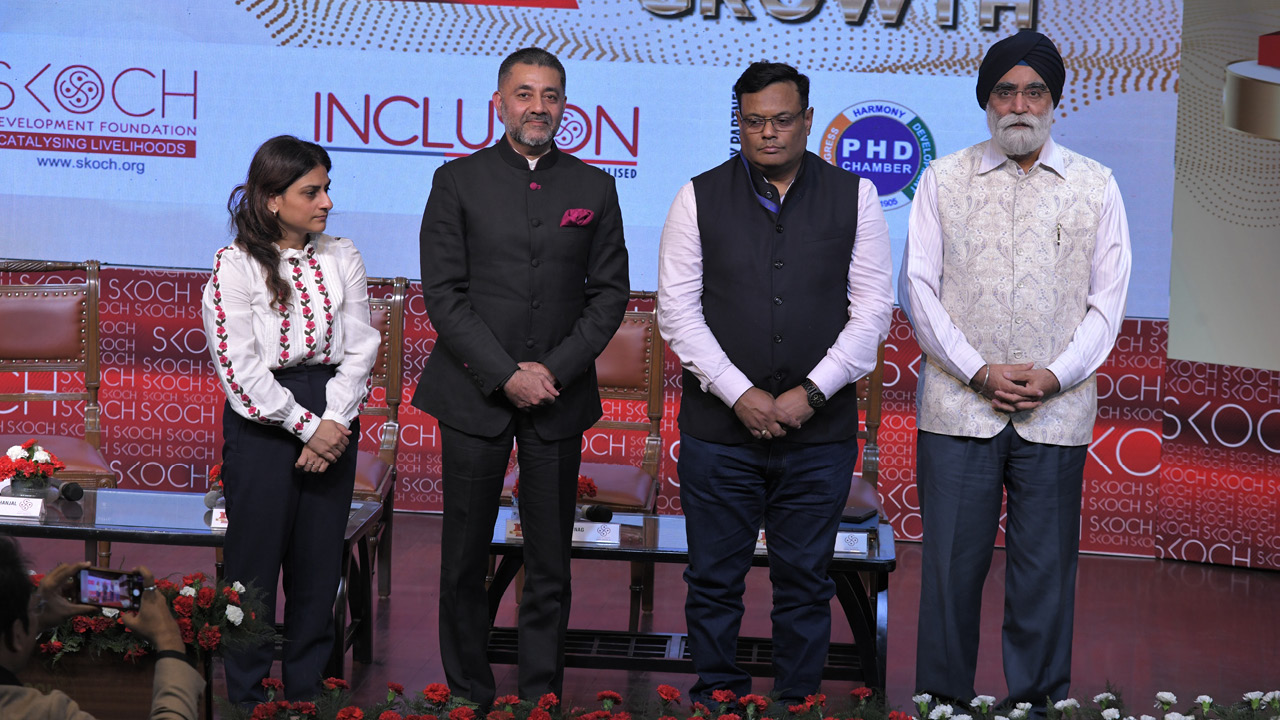
Mr Amitabh Nag at the 100th SKOCH Summit: New Dimensions in Inclusive Growth
Mr Amitabh Nag
CEO, Digital India Bhashini Division, MeitY
Key Points*
- The Bhashini mission has successfully developed AI language conversion models across most areas, with limited work pending in text-to-speech.
- The initiative began when AI was still in labs and relied on collaboration with 70 research institutes.
- Eight research consortiums were formed, each addressing specific problem statements.
- AI models are deployed as services through the National Hub for Language Technology (NLT).
- NLT hosts over 300 AI language models and serves around 300 customers.
- The platform processes approximately 6 million AI inferences daily across language services.
- Limited digital data in many Indian languages required large-scale field data collection.
- Parallel speech–text corpora were created using field-based mobile data capture.
- The mission is guided by five objectives, including inclusivity, accuracy, voice-first access, and real-life use cases.
- Open-source models and datasets support affordability, transparency, and trusted AI deployment.
* This content is AI generated. It is suggested to read the full transcript for any furthur clarity.
Transcript
Thank you. Happy to say that we are on track as far as the conversion models are concerned in all areas, except for a few areas of text-to-speech, which we are still working on.
These are the five problems that we solved, and how did we solve them. At the time when the mission started, artificial intelligence was still in labs. So we collaborated with about 70 research institutes and asked them to form around eight consortiums. Each consortium was given a problem statement, and based on those problem statements, the models were created and passed on.
Then the question was: how do these models render as a service? For that, an API platform was created, which is called the National Hub for Language Technology. The AI models are converted into services through APIs and rendered as a service. This National Hub for Language Technology, or NLT as it is called, is hosting more than 300 models as service APIs on its platform.
Today, NLT has approximately 300 customers, and the system is inferenced about 6 million times a day—around 60 lakh inferences per day—for various services such as automatic speech recognition, text-to-text, text-to-speech, and other functionalities.
One more issue we realized while developing these AI models was that only six to seven languages had enough digital data available in the system to train the models. The digital data that existed was limited to those six or seven languages. The rest of the data had to be created from the field through a unique exercise carried out across the country.
What we did was go to the field with handheld devices. We showed pictures on mobile phones and asked people to speak about them. When they spoke, we captured both the audio and the corresponding text, creating a parallel corpus. Having completed this activity, we are now in a position to serve, as I mentioned, around 300 customers with about 6 million inferences per day.
The crux of this initiative is to understand what we are looking at, especially since there are parallel initiatives by private organizations and multinational corporations as well. The mission was announced with a clear intent, and the initiative was carried forward with five basic objectives.
The first objective is that no language should be left behind. That is the first part of the activity. We covered 22 languages, and when we announced that we would do it for 22, others came back and said they would do it for 100. That is a good thing for the country, and we would like market forces to move forward.
The second objective is accuracy. Although this is an AI system, we are aiming for 100% accuracy. This depends on how much data we collect and how much training we give to the models. This is an ongoing journey.
The third objective is a voice-first approach. As Mr. Abhishek Singh also mentioned, voice-first is a strategy we have adopted because it helps transcend the language divide, bridge the digital divide, and bridge the literacy divide. With voice, people can communicate and get things done through machines.
The fourth objective is to focus on use cases and transactions that impact everyday life. For example, if I am reading a book in my language, I should be able to apply for a scholarship in my language. I should not be forced to move to English. If someone wants to learn English, they can, but language should not become a barrier for basic access and participation.
We want this system to be pervasive and ensure that no one feels they must learn another language or be doomed—a sentiment all of us may have heard at some point in time.
The fifth objective is affordability. This technology should be affordable. As a government mission, we want this technology to be open and available. Another important aspect of safe and trusted AI is that the models are open-sourced, and the datasets used to train them are also open-sourced, allowing for social audit. This is our first step toward building safe and trusted AI.
Language is the largest use case of AI, and this system is currently being used and is constantly evolving and developing. I will stop here, and in the next round, I will give examples of use cases—how we are transcending the language divide, the digital divide, and the literacy divide, and how we are increasing productivity.
Thank you. Thank you so much for giving us all the details about how this Bhashini initiative is going to work.