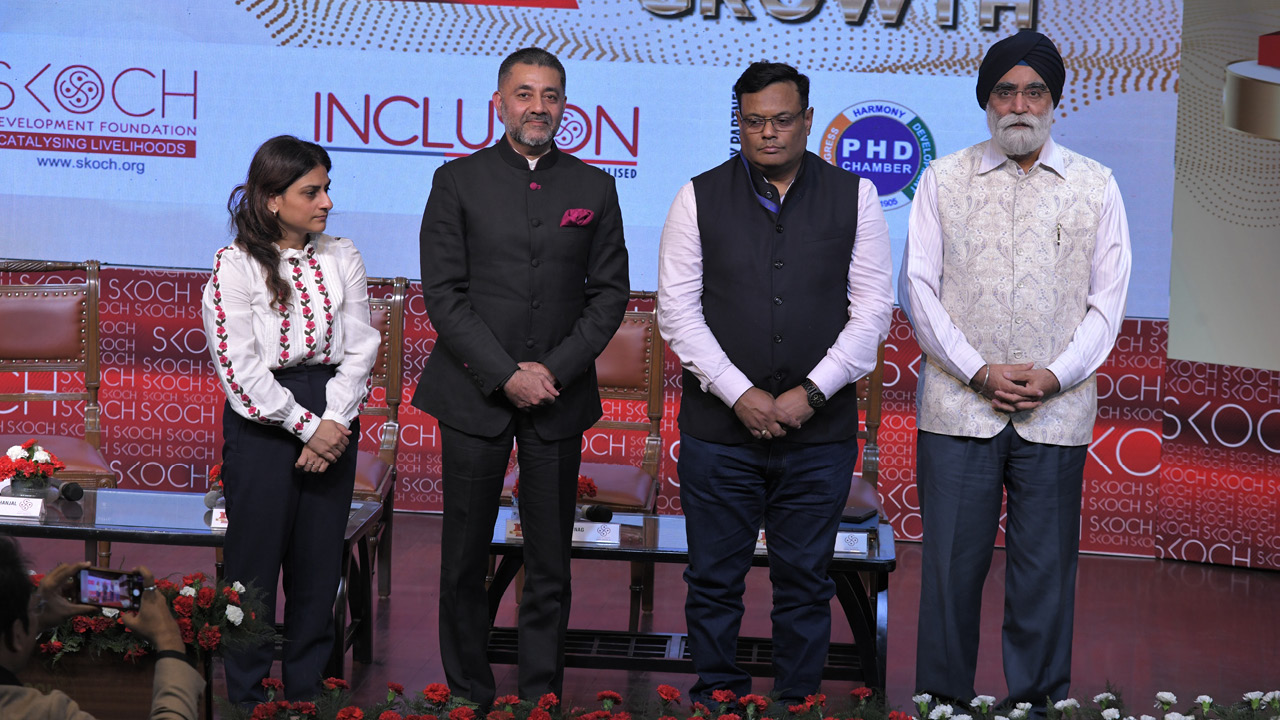
SKOCH Summit

Mr Rahul Johri
Chairman & Managing Director, WeGrow Financial Services Pvt Ltd
He has been in financial services for more than 33 years out of which for more than 30 years was in leadership positions across banks such as Bandhan Bank, DBS Bank, Barclays Bank, Standard Chartered Bank and ANZ Grindlays Bank. He has worked in various facets of banking like strategic business planning, management of retail business, distribution planning and management, operations and customer service.
Mr Rahul Johri at the 100th SKOCH Summit: New Dimensions in Inclusive Growth
Mr Rahul Johri
Chairman & Managing Director, WeGrow Financial Services Pvt Ltd
Key Points*
- Bridge Finance and Vector Finance have supported over five lakh financially excluded households in six years.
- Early microfinance conversations focused only on microcredit, with limited product awareness.
- Today, financially excluded borrowers discuss debit cards, MSME loans, and financial planning.
- Increased financial awareness has shifted borrower needs beyond basic microloans.
- All customers share five core financial needs: transactions, credit, insurance, planning, and remittances.
- Financial inclusion has expanded access, setting the stage for financial deepening.
- Financial deepening means moving beyond microcredit to MSME and enterprise loans.
- Risk mitigation products like health and home insurance are now in demand among low-income borrowers.
- The ecosystem is ready with players and products tailored for excluded households.
- The next phase of growth lies in offering a broader, integrated suite of financial services.
* This content is AI generated. It is suggested to read the full transcript for any furthur clarity.
Transcript
I represent a group of companies, primarily Bridge Finance and Vector Finance, both of which work with financially excluded borrowers, especially women. Over the last six years, we have been proud to support more than five lakh financially excluded households.
I would like to share a small anecdote from my personal experience. About nine or ten years ago, I went on a branch visit to a place called Panskura. During branch visits, one usually has lunch with the staff to better understand ground realities. I clearly remember that the entire conversation at that time revolved only around microcredit and microfinance. There was no discussion beyond that.
I recently compared this with another branch visit I made about a month ago to a branch in Chandrakona. The conversation there was far more evolved. One staff member spoke about a debit card not working. Another asked why we could not explore MSME loans. Someone else mentioned that customers had started talking about financial goal planning. There was also discussion around risk mitigation products such as home insurance, house insurance, and hospital cash insurance.
If we think about the basic needs of any customer, they typically fall into five categories. First, the need to transact—opening a bank account. Second, access to credit. Third, risk mitigation through insurance, whether life, home, or health. Fourth, financial goal planning. And finally, fund transfers and remittances. These five needs are universal across all customer segments.
What is significant today is that even financially excluded borrowers are actively talking about all these aspects. This indicates that access to information has increased and people are more aware of what financial services can offer them. The stage is now set for financial deepening.
For me, financial deepening has two key implications. First, moving beyond simple microcredit to offering products like MSME loans through MFIs. Second, introducing additional products such as home improvement loans and WASH-related financing.
Today, borrowers require a much wider range of financial products. At the same time, the ecosystem is ready—there are distinct players supporting this segment, and product manufacturers are now able to design solutions specifically for financially excluded households. The next stage of financial deepening is clearly within reach.