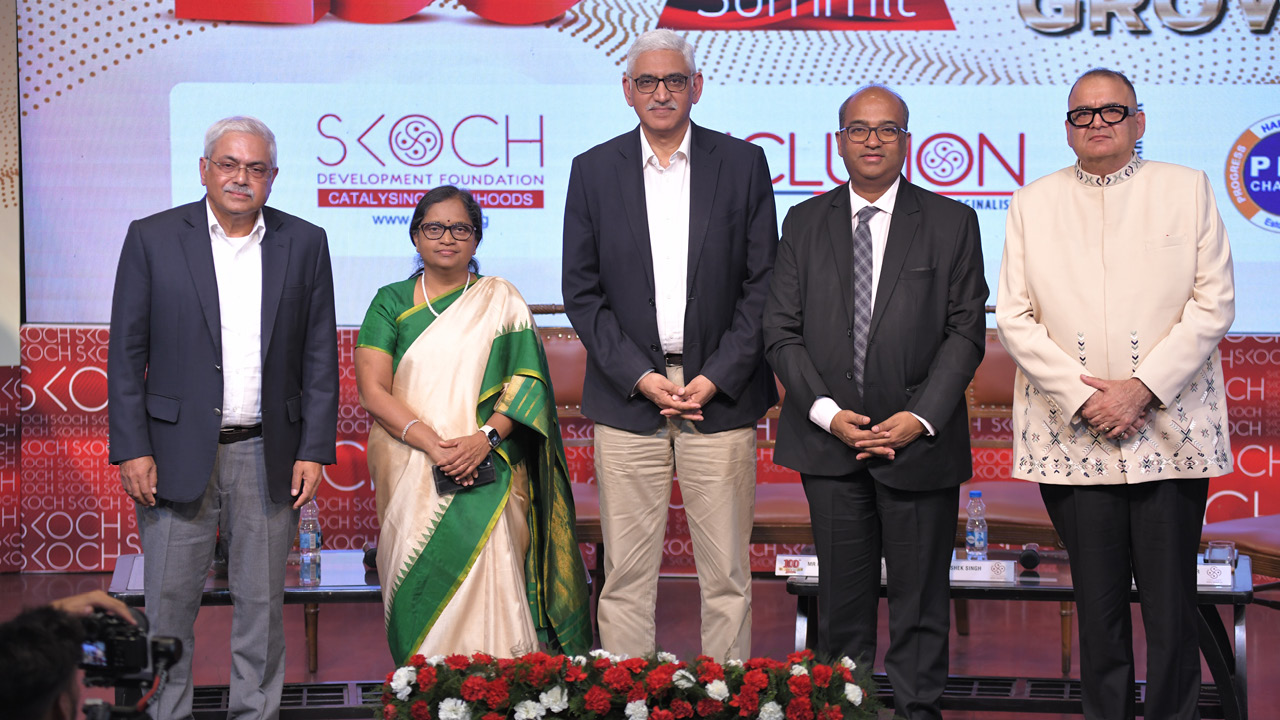
SKOCH Summit
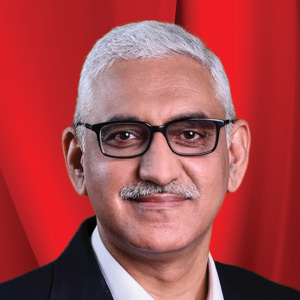
Mr Rajesh Awasthi
Vice President Sales – Strategic Initiatives, Tata Communications
Mr Rajesh Awasthi at the 100th SKOCH Summit: New Dimensions in Inclusive Growth
Mr Rajesh Awasthi
Vice President Sales – Strategic Initiatives, Tata Communications
Key Points*
- Tata Communications’ core contribution lies in building digital infrastructure that enables government and citizen services.
- India’s digital growth has been powered by global connectivity and subsea cable investments.
- Secure, sovereign digital public infrastructure is essential for managing government data.
- Data sovereignty requires both domestic hosting and governance under Indian law.
- Government initiatives like PMJDY and ABHA depend on sovereign cloud environments.
- Tata Communications established a dedicated Government of India Community Cloud for this purpose.
- Artificial intelligence will transform jobs by augmenting productivity, not eliminating work itself.
- Organizations and individuals who fail to adopt AI risk falling behind.
- AI offers India a rare opportunity to compete globally on a level playing field.
- Collaboration between government, infrastructure providers, and industry is key to leapfrogging into the AI era.
* This content is AI generated. It is suggested to read the full transcript for any furthur clarity.
Transcript
Much of what I wanted to say has already been covered by Mr. Abhishek Singh. Where Tata Communications has been contributing is primarily on the infrastructure side—enabling the digital framework created by the government to be effectively used by citizens, businesses, and consumers.
This is the area we have been working on, and we have been fortunate to collaborate with several panel members here on critical national projects. As Sameer mentioned, earlier VSNL was the gateway to the internet for India. When Tata Communications took over, one of our key focus areas was to make this infrastructure global in nature.
That is where we made global acquisitions, built subsea cable networks, and strengthened our international footprint to support the growing demand for internet-first services. Many of the services delivered in India today—especially in IT and digital services—have been enabled by robust connectivity, and that is where our initial contribution lay.
As digital initiatives expanded across organizations and government, we felt the need to contribute further. One area that is becoming increasingly important is ensuring that the data being digitized is hosted on secure, sovereign digital public infrastructure.
When we talk about sovereignty, it is not only about data center residency within the country, but also about ensuring that the data is governed by the laws of the land. This was a key requirement for many Digital India initiatives—such as PMJDY-related platforms and health initiatives like ABHA—where deployment on a sovereign cloud environment was essential.
To support this, we created a Government of India Community Cloud, hosted in Mumbai, fully compliant with government frameworks, and dedicated exclusively to hosting data for Government of India customers.
What is equally important—and this was also highlighted by Mr. Abhishek—is the role of artificial intelligence. As one industry leader aptly said, AI is not going to take away jobs; rather, it will perform certain tasks hundreds or thousands of times better than humans. The people most at risk are those who do not use AI. Those who adopt AI will see their services and products gain far greater acceptance.
My request to everyone here is this: now is the time to adopt AI. This is a level playing field. While Digital India gave us a head start compared to much of the Global South, AI is an area where India can be at par with, or even outperform, developed economies.
I urge each of you to look at your own domain and consider how AI can be integrated into your work to enhance outcomes and impact.
At Tata Communications, we are working closely with the Ministry of Electronics and IT to provide the right compute infrastructure, ensure effective data management, and enable secure deployment of AI workloads. That is the role we see for ourselves as a service provider, and that is where we would like to collaborate with all of you.
I will not go into further detail, but I firmly believe this is the moment for India to leapfrog technologically, adopt AI at scale, and use it as a driver for national growth—moving us closer to our goal of becoming a developed nation.
Thank you very much.