SKOCH Summit
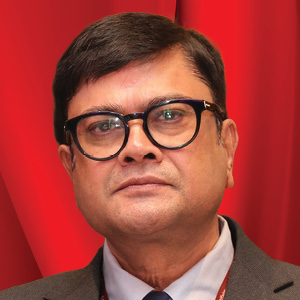
Mr Sanjay Kumar
Secretary, School Education, Ministry of Education
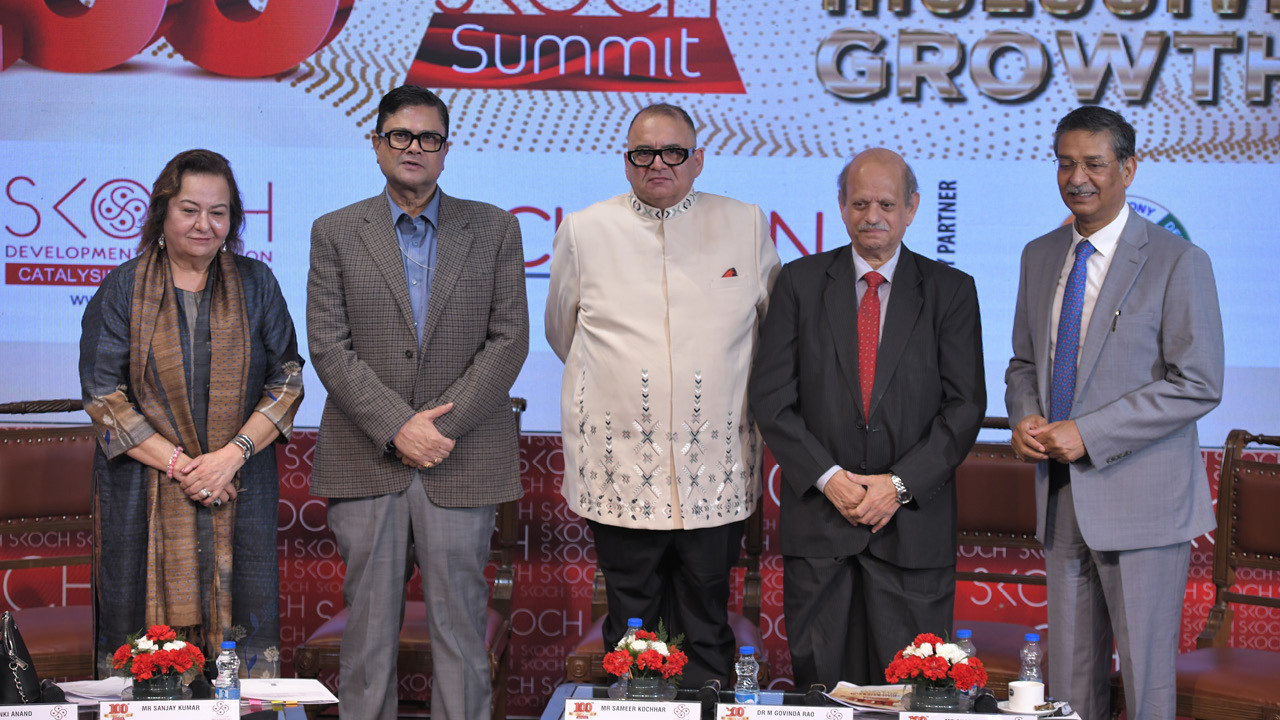
Mr Sanjay Kumar at the 100th SKOCH Summit: New Dimensions in Inclusive Growth
Mr Sanjay Kumar
Secretary, School Education, Ministry of Education
Key Points*
- Inclusion is central to India’s future growth, especially in an economy increasingly driven by technology and inequality.
- Education is the most powerful instrument for inclusion, alongside health, in transforming individual and national outcomes.
- India’s expected years of schooling are significantly lower than developed countries, limiting productivity and GDP growth.
- Structural imbalance in the school system, with too many primary and too few secondary schools, drives dropouts.
- Small, fragmented schools increase costs and reduce learning outcomes; integrated schools improve retention.
- Major dropouts occur during school transitions, especially from primary to secondary and secondary to higher secondary.
- Wide disparities across state school boards affect access to national-level examinations and higher education.
- Mother-tongue-based and multilingual education is critical for equitable learning and inclusion.
- Children with special needs and board-exam failures are under-served and require alternative education pathways.
- Escaping the middle-income trap requires inclusive, outcome-driven education focused on skills, innovation, and culture.
* This content is AI generated. It is suggested to read the full transcript for any furthur clarity.
Transcript
Pinky Anand ji, Dr. Gursharan, ladies and gentlemen.
You know, adding two zeros to one has always been a very important thing in our lives. One hundred holds a special magic, and today we are here for the 100th SKOCH Summit. So congratulations to Samir ji and his entire team for celebrating this milestone. May you follow it up, and may we all live to see—not the third zero—but at least one followed by two zeros for the time being.
I was listening to Professor Rao speaking about taxes, and I was reminded of that old saying of Benjamin Franklin: death and taxes are the only two certainties in life. We will continue to pay taxes, but how we pay taxes will continue to change.
I am very happy to be here, and I have been given the topic of how education will bring inclusion. Inclusion is something we are all grappling with. Samir ji talked about spatial inclusion, then there is social inclusion, and then economic inclusion. No matter which aspect you look at, you will always find a need for inclusion—especially in India, where socially and economically we have historically been a fragmented society.
Since Independence, politics has attempted to bring some amount of inclusion in our affairs. But the way the economy is evolving and the way technology is driving that evolution, inclusion today is far more important than it has ever been.
I was watching a video by Bernie Sanders where he mentioned that the top three richest people in the US hold more wealth than the bottom 50% combined. Look at the kind of economic disparity we are witnessing. This becomes even more striking when we see that among the top ten richest people in the world, nine are technology-driven, and the tenth—Bernard Arnault of Louis Vuitton—is catering to the demands of the rich.
Technology today is highly proprietary. How do we bring inclusion in the generation and ownership of technology? That is a question we can debate endlessly. Take artificial intelligence—less than 100,000 people globally are involved in AI, and perhaps only 10,000 are actually creating AI content. In a world of eight billion people, this tiny group is driving the entire AI discourse. How do we make this inclusive? That remains a major question.
Amidst all this, two things stand at the foundation of inclusion. First, good health—because life is about living, and living depends on health. Second, education. If there is one instrumentality that can bring inclusion to all, it is education. Everyone in this hall is where they are because of education—because of the institutions they attended and how they imbibed learning. There is no getting away from it.
Today in India, the expected years of schooling is about 12.8 years. That means a child born today can expect to receive 12.8 years of schooling, including higher education. Developed countries are at 16–17 years, with a maximum of 18. We have a long way to go. Research shows that every additional year of schooling adds 37% to GDP and 10% to productivity. If we increase expected schooling to 15 or 16 years, the impact on the economy would be enormous.
The question is: how do we do this?
For the purpose of inclusion, I will focus on two key aspects of education. When the Constitution came into force in 1950, education was on the State List. In 1976, it moved to the Concurrent List through a constitutional amendment. Even before that, the Government of India had established institutions like IITs and IIMs, and commissions such as the Kothari Commission in 1964–66.
The New Education Policy of 1986 introduced several pilot programs, and education eventually became a fundamental right through the 86th Constitutional Amendment in 2000. Article 21A led to the Right to Education Act in 2009. Before that, initiatives such as Sarva Shiksha Abhiyan, launched in 2000, focused on increasing enrolment and bringing every child into school.
The RTE Act introduced geographical norms—no primary school should be more than one kilometer away, and no middle school more than three kilometers away. Between 2000 and 2015, there was massive expansion of primary schooling.
Today, India has about 14.6 lakh schools, including private, government, and government-aided institutions. Government and aided schools number about 10.5 lakh. Of all schools, 50% are primary schools. As we move up the pyramid, there is a structural imbalance: 30% are upper primary, 10% secondary, and 10% higher secondary.
If we want 100% gross enrolment and retention, the system must be cylindrical—not pyramidal. Every child entering Class 1 should progress to Class 12. The National Education Policy 2020 sets targets of 100% GER in secondary education by 2030 and 50% GER in higher education by 2035. Currently, higher education GER is around 29%.
To achieve this, we need to expand secondary and higher secondary schooling. This requires investment and better management.
The second major issue is school size. The RTE Act led to a proliferation of schools, making many of them very small. Of the 10.5 lakh government schools, 37% have enrolment below 50—about 4 lakh schools. We send 260 million children to 14.6 lakh schools. The average school size is 172 students; for government schools alone, it is 132.
In comparison, the average school size is around 500 in China and the US, and 461 in Israel. There is a sweet spot between access and learning outcomes. Excessive fragmentation increases costs and reduces outcomes. Larger, integrated schools are needed.
Seventy-five percent of children require more than three admissions during schooling due to school transitions. Dropouts occur mainly during transitions—from Class 5 to 6, 8 to 9, and 10 to 11. Data shows that integrated schools from Class 1 to 12 have much higher retention rates.
Another major challenge is curriculum and assessment. India has about 60 school boards. CBSE runs about 31,000 schools, ICSE around 3,200. The rest are state boards, each with different curricula and assessments. NEP 2020 calls for equivalence in curriculum and assessment nationwide.
Centralized exams like JEE and NEET reveal large disparities. In NEET alone, 24 lakh students appeared last year. CBSE and ICSE students disproportionately succeed, while many state boards lag behind. States must seriously examine this data.
Language is another critical issue. NEP recommends mother-tongue instruction at least till Class 5, preferably till Class 8. Learning in an unfamiliar language affects inclusion. Multilingualism should be encouraged, but foundational learning must happen in the mother tongue.
Children with special needs are another concern. Only 0.89% of enrolled children are identified as CWSN, whereas the expected figure is 3–4%. Kerala performs best at 2.2%. Many children are either not enrolled or not properly identified.
Last year, 55 lakh children failed Class 10 and 12 board exams. Where do they go? Many drop out. We are working with the National Institute of Open Schooling and state open boards to re-integrate these children.
Finally, our curriculum is overly academic and mark-centric. Excessive competition leads to stress and exclusion. Education must focus on learning outcomes, skills, experiential learning, and cultural pride, including Indian knowledge systems.
India aspires to become a developed nation by 2047. Some fear a middle-income trap. But the only way to escape that trap is through inclusive, quality education driven by innovation and learning outcomes.
Inclusive education is the foundation of inclusive growth. With these thoughts, I thank you for listening, and I hope this discourse continues.
Thank you.