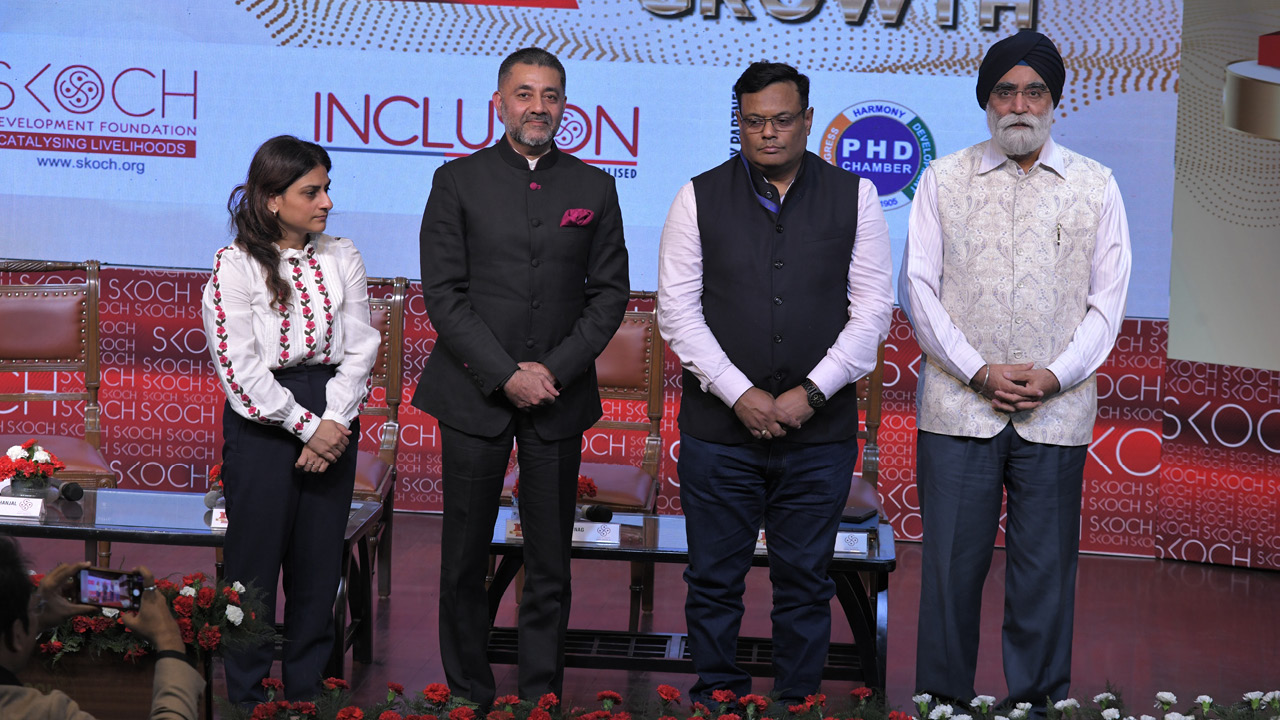
SKOCH Summit

Mr Subrata Ghosh
Managing Director, Servitium Micro Finance Private Limited
Mr Subrata Ghosh at the 100th SKOCH Summit: New Dimensions in Inclusive Growth
Mr Subrata Ghosh
Managing Director, Servitium Micro Finance Private Limited
Key Points*
- Government initiatives have expanded financial inclusion through RRBs and SHG–Bank linkage programs.
- Despite progress, rural customers still face limited access to formal bank credit.
- RBI’s Malegam Committee led to the creation of NBFC-MFIs to bridge the credit gap.
- Microfinance institutions serve socially isolated beneficiaries excluded from formal banking.
- The microfinance sector maintains a high recovery rate of around 99%.
- Digitalization has reduced loan disbursement time from weeks to just a few days.
- High transaction costs and weak rural infrastructure hinder digital adoption.
- Limited access to low-cost funding increases interest rates for MFI borrowers.
- Dependence on NBFC intermediaries raises the cost of funds for MFIs.
- Government-supported digital platforms and fintech-based P2P lending can reduce costs and expand credit access.
* This content is AI generated. It is suggested to read the full transcript for any furthur clarity.
Transcript
The Government of India has taken several initiatives in financial inclusion, such as increasing banking penetration in rural areas, strengthening Regional Rural Banks (RRBs), and implementing Self-Help Group–Bank linkage programmes.
However, we have observed that customers and rural people are still not getting adequate credit facilities from formal banking institutions, including RRBs. In this context, the RBI recommended the formation of Microfinance Institutions through the Malegam Committee, and in 2011 RBI introduced the NBFC-MFI license.
After the introduction of NBFC-MFIs, the microfinance sector expanded rapidly. Over the years, one commercial bank obtained a banking license from the microfinance sector, and several institutions received Small Finance Bank licenses. These institutions now provide credit facilities to customers.
Microfinance institutions also provide financial services to many beneficiaries who are socially isolated. We have seen that these beneficiaries do not get loans from formal institutions, and only microfinance organizations are lending to this segment. The recovery rate in this sector has been consistently high—around 99%.
At present, the sector serves more than one crore customers. A few years ago, around 2012–13, loan sanctioning and disbursement by MFIs used to take three to four weeks. With digitalization, we are now able to disburse loans within three days.
However, we are facing major challenges in digitalization. The first challenge is high transaction costs. The second is low infrastructure—such as lack of reliable internet connectivity and electricity availability for 24 hours in rural areas.
Another major challenge is funding. Commercial banks are not very interested in providing regular funding directly to this sector. Most MFIs receive loans indirectly through NBFCs like Bajaj and Shriram. Because of this structure, the cost of funds is high, and MFIs are unable to offer low-interest loans to beneficiaries.
To overcome these challenges, we suggest a few solutions. First, the government should provide digital platforms free of cost to MFIs. Second, peer-to-peer (P2P) lending through fintech platforms can help MFIs access lower-cost funds, which will allow them to provide loans at lower interest rates to beneficiaries.
Thank you. Thank you to the SKOCH Group for giving me this opportunity.