SKOCH Summit

Ms Pinky Anand
Senior Advocate, Supreme Court of India
Pinky Anand, a trustee of The Arts and Cultural Heritage Trust is a designated senior advocate at the Supreme Court of India and the incumbent Additional Solicitor General of India. A doctorate of law, graduate of Harvard Law School, an Inlaks scholar, honorary professor at Amity Law School, she is the second woman in India to have been awarded this high constitutional law office. Her laurels include being an alternate country councillor (India) of LAWASIA and the vice president of the Bar Association of India. She has been the recipient of the National Order of Merit awarded by the President of France, and has several awards to her credit, including those for excellence in law awarded by FICCI, Lions Club, Amity University, Bharat Nirman, PHD Chamber for Progress, Harmony and Development. She has also been a spokesperson for the Bharatiya Janata Party and was even leading its all-India legal team at one point. As a founding member of the BRICS Legal Forum, she has represented India in various Brazil, China and India meets.
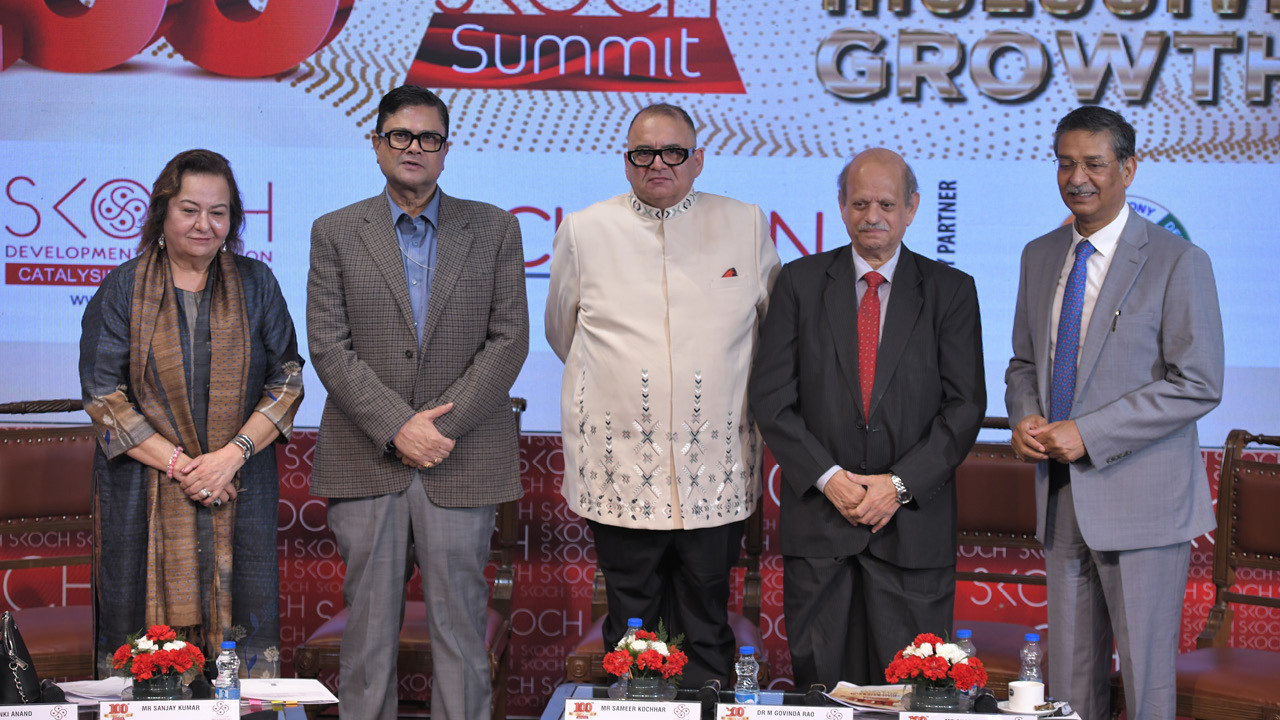
Ms Pinky Anand at the 100th SKOCH Summit: New Dimensions in Inclusive Growth
Ms Pinky Anand
Senior Advocate, Supreme Court of India
Key Points*
- Strategic planning and foresight are essential as India transitions from a developing to a near-developed economy.
- Retrospective taxation, though constitutionally permissible, creates serious uncertainty for business and investment.
- GST, digitization, and demonetization faced resistance but ultimately strengthened revenue generation.
- Retrospective tax liabilities disrupt business planning and can render operations unviable.
- The mining royalty judgment highlights the tension between state revenue needs and business certainty.
- The online gaming sector faces disproportionate retrospective taxation, raising constitutional and economic concerns.
- Excessive or unfair taxation risks driving businesses and innovation to other jurisdictions.
- Investor confidence depends on predictability, fairness, and stable tax policy, not retrospective changes.
- Past cases like Vodafone and Cairn show the high cost of retrospective taxation to India’s credibility.
- Balanced, proportionate, and prospective taxation is critical for growth, startups, employment, and innovation.
* This content is AI generated. It is suggested to read the full transcript for any furthur clarity.
Transcript
Ladies and gentlemen, I think we have had a very exciting beginning—serious to some extent, but that perhaps reflects the direction in which we are heading as a country.
What I particularly like about the concept that Dr. Samir Kochar has put together is the emphasis on thinking and planning. I remember visiting several think tanks across the world and participating in discussions on what to do and how to plan. That, I believe, is the direction we need to move in—planning ahead, understanding where we have reached, and deciding where we want to go.
We have reached a very important milestone. We are no longer an underdeveloped country; we are clearly a developing one, and perhaps even moving toward being developed—maybe as the third-largest economy. Today, when we travel across the world, people look at India in terms of what we have achieved and what lies ahead. We have gone through difficult phases, and those experiences have shaped our vision.
I am speaking today on the issue of retrospective taxation and tax activism. It may sound like a dry subject, but it has enormous implications for business, revenue, and economic growth.
We have heard erudite speakers today—Mr. Bhat Lal, who has evolved into a philosopher over time; Sanjay, whom I have known since his Jharkhand days—Jharkhand perhaps a little ahead, but Bihar also catching up; and Dr. Rao, who has been deeply involved in GST and fiscal reforms.
I remember the time GST was introduced. There was enormous opposition, with fears that it would create hurdles and obstacles. Yet, the revenue generated through GST, combined with digitization and demonetization, has more than justified its existence.
Against this background, let me turn to retrospective taxation. India has a history of justifying retrospective taxation. It is constitutionally permissible under Articles 245, 246, and 265. But the real question is: has it paid off? Has it benefited us in the long run? Today, that question remains open.
Consider the recent mining royalty judgment, where taxes were imposed retrospectively from 2005. States like Jharkhand were directly involved, with massive revenue implications. From a business perspective, planning is done based on existing tax structures—covering wages, infrastructure, and compliance. Retrospective imposition of large tax liabilities completely disrupts this planning.
I understand that states need revenue and development funds. But prospective taxation is fundamentally different from retrospective taxation. That distinction is crucial.
Another major issue is online gaming. Globally, online gaming has grown significantly. Earlier, there was a distinction between games of skill and games of chance. Today, that distinction has been removed, and a 28% retrospective tax has been imposed.
The online gaming industry was projected to generate revenues of around $5 trillion by 2025. With this tax regime, several questions arise:
Do businesses have a fundamental right under Article 19(1)(g)?
Can the state impose a disproportionately high tax?
Why would businesses operate here when alternatives exist in other jurisdictions, especially in a virtual global economy?
If we want revenues, education, rights, and prosperity, we must allow businesses to function and grow. Every country needs taxes, but disproportionate taxation has consistently been frowned upon by the Supreme Court—whether in *CIT v. Vatika* or other judgments.
The test is fairness, public interest, and proportionality. Does the tax align with its stated objective? Does it serve a legitimate public purpose?
In the mining royalty case, states argued that others were benefiting while they were not, and they needed funds for development. That concern is understandable. But balance is essential.
Online betting and gaming are now before the Supreme Court, with around 140 companies involved. Issues include retrospective taxation, quantum of tax, and violation of fundamental rights.
We must also consider foreign investment. Retrospective taxation seriously undermines investor confidence. Vodafone and Cairn are classic examples—years of litigation, international arbitration, and ultimately reversal of retrospective taxation through the Finance Act, 2021. Enormous sums were paid back, but the damage to investor trust was already done.
Investor faith—both foreign and domestic—depends on certainty and predictability. Businesses need to know the rules of the game in advance. Retrospective changes destroy that certainty.
There is also the issue of indirect taxes being passed on to consumers. Retrospective levies become impractical because the consumers have already moved on.
We are at a crossroads. Should we have retrospective taxation at all? Or should we plan prospectively and transparently?
If retrospective taxation is unavoidable, it must be proportionate and not destroy businesses or make operations unviable. There is also the question of whether tax should be levied on the full betting amount or on gross gaming revenue, as is the global practice.
While these matters are before the courts, policy clarity should not wait for litigation. The executive, legislature, judiciary, and civil society must work together.
Retrospective taxation leads to loss of employment, revenue, and investment. It affects tier-2 and tier-3 cities, drives out small players, and discourages startups—an area where India has otherwise performed exceptionally well.
Innovation and entrepreneurship are critical. Digitization has already spawned multiple new business models, creating employment and economic potential. That is the direction we must encourage.
Retrospective taxation is not just a sting—it is a serious deterrent. We must examine it carefully and bring clarity and balance into our tax policy.
I hope all of you will participate in this dialogue—as citizens, planners, policymakers, and stakeholders.
Thank you very much.