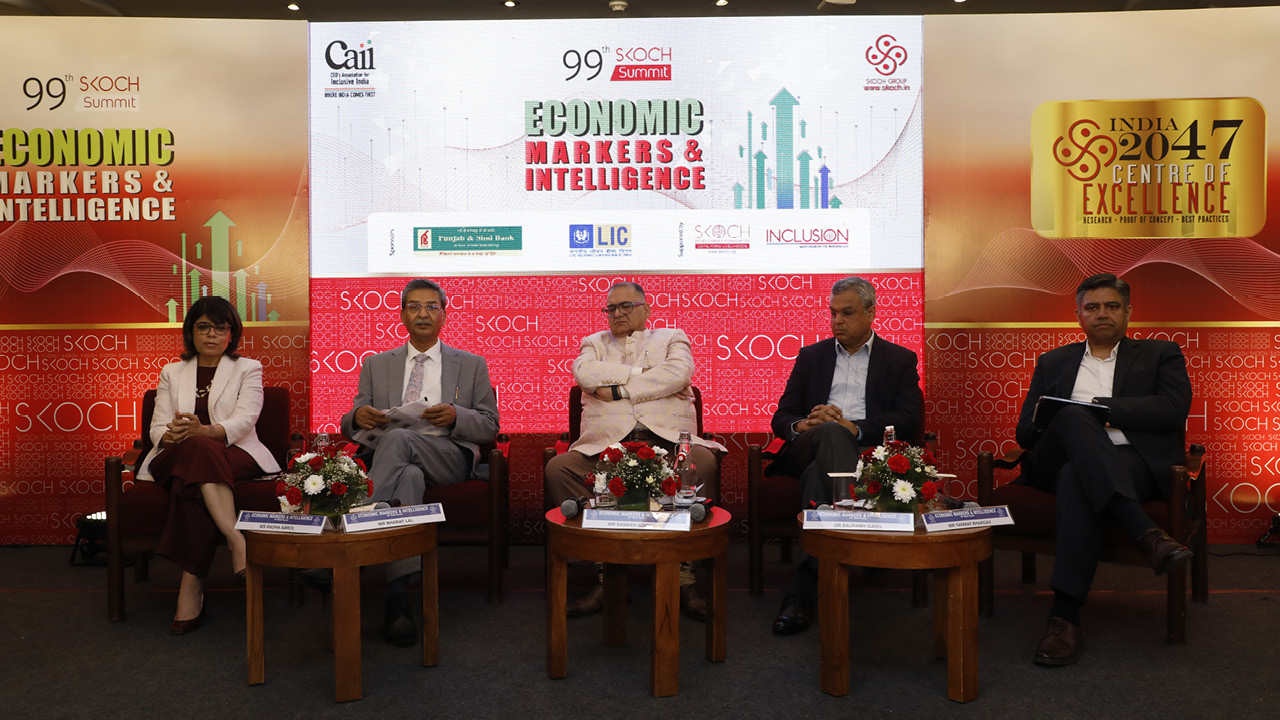
SKOCH Summit

Dr Saurabh Garg
Secretary, Ministry of Statistics and Programme Implementation (MoSPI)
Dr Saurabh Garg at the 99th SKOCH Summit: Economic Markers & Intelligence
Dr Saurabh Garg
Secretary, Ministry of Statistics and Programme Implementation (MoSPI)
Key Points*
- Viksit Bharat 2047 requires clear, measurable indicators to track progress toward developed-nation status.
- A USD 30 trillion GDP and sharply higher per capita income are key economic milestones.
- Growth must be inclusive, not limited to income expansion alone.
- Universal access to electricity, water, sanitation, banking, clean fuel, and broadband is essential.
- Improved health outcomes, life expectancy above 80 years, and affordable healthcare are core goals.
- Education, skilling, and higher gross enrollment ratios are critical development pillars.
- Female labour force participation must rise substantially to support long-term growth.
- Green growth and climate action are mandatory for sustainable development.
- Digital and physical infrastructure underpin economic inclusion and productivity.
- Measuring and monitoring progress is essential to achieving the Viksit Bharat 2047 vision.
* This content is AI generated. It is suggested to read the full transcript for any furthur clarity.
Transcript
Good morning. My friend and colleague Bharat Lal, Mr. Kochhar, Mr. BRW, and other colleagues who are here, and colleagues from across different industries and all others who are present.
Mr. Kochhar suggested that I talk about the markers of Viksit Bharat, and I think that is something relevant since I am in the Ministry of Statistics and we bring out different indicators for the government—whether it is GDP numbers, growth rates, inflation numbers, employment and unemployment, and a host of other socio-economic parameters, including the SDG National Indicator Framework.
I thought this is extremely relevant in terms of what metrics we are going to use when we talk about Viksit Bharat 2047. The Honorable Prime Minister has mentioned this a number of times, and I am using that as the basis of what I am going to talk about. There was even a discussion in the NITI Aayog Governing Body on what Viksit Bharat 2047 means, and I think even in the Budget, the Honorable Finance Minister mentioned some possible indicators of what we are talking about.
So I thought I would use that and mention what could be used for measuring, or what kind of milestones we will use for talking about Viksit Bharat 2047.
One thing that has been very clearly stated is that Viksit Bharat 2047 would be a developed nation. This has been repeated many times, but the question is: what does a developed nation mean? What are we trying to say in terms of that?
We are already the fifth-largest economy and are expected to become the third-largest within the next few years. One of the key numbers would be the expected GDP. We are currently around USD 3.3–3.4 trillion, and USD 30 trillion has been mentioned as the target for Viksit Bharat 2047. This translates into per capita income rising from around USD 2,400 today to somewhere around USD 18,000, which is being discussed as the target.
That becomes a very clear marker. But per capita income alone is not enough. It has to be inclusive growth—an inclusive economy—and universal access to basic amenities has been very clearly highlighted.
There are four or five areas that come to mind immediately: electricity, drinking water, banking facilities, sanitation, clean fuel, and also high-speed broadband, which becomes a basic amenity as we move ahead. These six areas have been mentioned in terms of universal access, meaning 100 percent coverage. We may reach this much earlier because in many of these areas we are already close to 100 percent.
In terms of electricity, under Saubhagya schemes we have electrified all villages and almost all households. In sanitation, we are above 80 percent, with many villages declared open defecation free. Under Swachh Bharat, about 10 crore LPG connections have been provided. In each of these areas, there are specific programs being implemented.
But it is not enough to talk at a very broad level. We need to ensure how we achieve 100 percent coverage, and these six areas have been identified clearly.
Another pillar mentioned repeatedly is healthy life, with high life expectancy and access to world-class, affordable health services. Life expectancy is currently around 68.6 years for males and 71.4 years for females. In the next four to five years, we expect to reach around 70–75 years, and by 2047 we should cross 80 years, comparable to global levels.
Affordability is addressed through programs like Ayushman Bharat and PM Poshan, which focuses on child nutrition. Infant mortality rates have already declined to below 28 and are expected to reach low single digits over the next 25 years.
Health, basic amenities, and per capita income are important, but they are not sufficient markers of a developed nation. Another key marker is education and skills. Literacy rates are already close to 80 percent and are expected to become universal well before 2047.
The Gross Enrollment Ratio (GER) in higher education is currently around 30 percent and is expected to reach 50 percent by 2030 under the New Education Policy. Eventually, GER is expected to approach 100 percent, including not just traditional higher education but also skilling. A mix of graduates and skilled individuals will be critical for becoming a developed nation.
There are many programs supporting this, such as Kaushal Vikas Yojana, Samagra Shiksha, and Schools for Rising India. This year’s budget also placed a clear focus on apprenticeship and skilling, along with increasing female labor force participation. Female LFPR is currently around 37 percent, and expectations are that it could reach 70–75 percent over the next couple of decades.
The budget also announced initiatives such as working women hostels and expansion of crèches through anganwadis.
Another critical pillar is green growth and climate action. Unless we take strong steps here, we cannot be a developed nation. India has committed to 500 GW of non-fossil energy capacity by 2030 and to meeting 50 percent of energy consumption from renewable sources. We have already reduced carbon emissions intensity by 33 percent.
Elimination of extreme poverty is another marker. Over the last 10 years, around 25 crore people have been lifted out of poverty. Recent household consumption expenditure surveys show that food as a share of total consumption has fallen significantly, and cereal expenditure has dropped to single digits, indicating rising living standards.
Finally, infrastructure—including digital infrastructure—is critical. Roads, telecom, and digital public infrastructure have transformed the economy. A decade ago, few would have imagined that nearly 100 percent of Indians would have a biometric digital identity. Aadhaar has revolutionized service delivery and enabled digital public infrastructure.
Broadband access, mobile connectivity, bank accounts, and digital payments are now widespread, alongside physical infrastructure such as roads and airports.
These are the different pillars one would use to mark or measure Viksit Bharat. We already have strong ground-level activities ensuring progress. You can monitor only what you measure, and unless you monitor, you will not reach your goals.
The fact that we are here discussing markers for Viksit Bharat 2047 shows the confidence we have in achieving our goal of becoming a developed nation.
I thank the SKOCH Group for initiating this discussion on markers for Viksit Bharat. As it is often said, you can treasure only what you measure, but you also need to measure what you treasure. If we treasure becoming a developed nation by 2047, it is necessary that we measure it.
Thank you.