SKOCH Summit





Agenda
0930 - 1200
Digital Financial Intelligence and Money Laundering in a Digital World
Markers of Viksit Bharat: Dr Saurabh Garg, Secretary, Ministry of Statistics and Programme Implementation (MoSPI)
Summary: The speaker outlines key measurable markers for achieving Viksit Bharat 2047 as a developed nation. These include rapid GDP growth toward a USD 30 trillion economy with significantly higher per capita income. Universal access to basic amenities, healthcare, education, skilling, and digital infrastructure are highlighted as core pillars of inclusive development. Emphasis is placed on improved life expectancy, higher female workforce participation, and elimination of extreme poverty. Green growth and climate action are identified as essential for sustainable development. The speaker stresses that clear metrics and continuous monitoring are critical to achieving the 2047 vision.*
View Full Transcript

Future of Business: Harmonising Human Rights and Sustainability: Mr Bharat Lal, Secretary General, CEO, NHRC
Summary: The speaker emphasizes that India’s future economic growth must be balanced with human rights, sustainability, and social responsibility. As India integrates deeper into global supply chains, businesses will face non-tariff barriers related to labor standards, environmental practices, and ESG compliance. Ignoring mental health, worker welfare, and environmental limits poses long-term risks to society and economic stability. Climate change and water scarcity are highlighted as critical constraints on development. Businesses are urged to align with constitutional values and adopt self-regulation before external enforcement becomes necessary. Sustainable and humane business practices are presented as essential for long-term competitiveness and national well-being.*
View Full Transcript

Mr Sameer Kochhar, Chairman, SKOCH Group
Summary: Mr Sameer Kochhar critiques global indices for misrepresenting India through flawed indicators, opaque methodologies, and ideological bias. These rankings increasingly function as non-tariff barriers affecting investment, exports, sovereign ratings, and global perception. In response, Scotch shifted from contesting global indices to building India’s own data-driven, state-level indices grounded in field research. Their approach combines quantitative metrics with qualitative project outcomes to measure governance and compliance efficiency. New indices span governance, digital inclusion, human rights, social inclusion, and responsible digital gaming. The speaker stresses that credible, indigenous measurement frameworks are essential for India’s 2047 developed-nation ambition.*
View Full Transcript

Mr Tanmay Bhargav, Partner, Risk Advisory, KPMG India
Summary: The speaker explains how digital gaming is becoming a major part of India’s digital economy but also introduces complex financial and regulatory risks. Virtual assets such as cryptocurrencies, NFTs, gaming tokens, and in-game items can be misused for money laundering due to anonymity, decentralization, and valuation challenges. Gaming platforms enable conversion of virtual currencies into real money through microtransactions and secondary markets. India currently faces fragmented regulation across RBI, SEBI, tax authorities, and others, with no unified framework. Retrospective taxation on gaming has created uncertainty and negatively impacted investor confidence. While FATF assessments show improved awareness and controls, stronger monitoring and regulatory clarity are still required.*
View Full Transcript

Ms Radha Abrol, Managing Director, Accenture
Summary: The speaker highlights India’s digital transformation and the need to shape its own narrative rather than accept Western misinterpretations. Drawing from personal experience as a parent, she underscores the vulnerability of children and teenagers in the rapidly expanding digital gaming ecosystem. She stresses the urgent need for strong, holistic regulation covering data protection, financial transparency, mental health, and consumer safety. Global gaming regulation is fragmented, and India currently lacks comprehensive industry-specific guidelines. Regulation must balance innovation with protection to avoid harming growth. She strongly criticizes retrospective GST taxation, calling it damaging to investor confidence and democratic governance.*
View Full Transcript

1220 - 1430
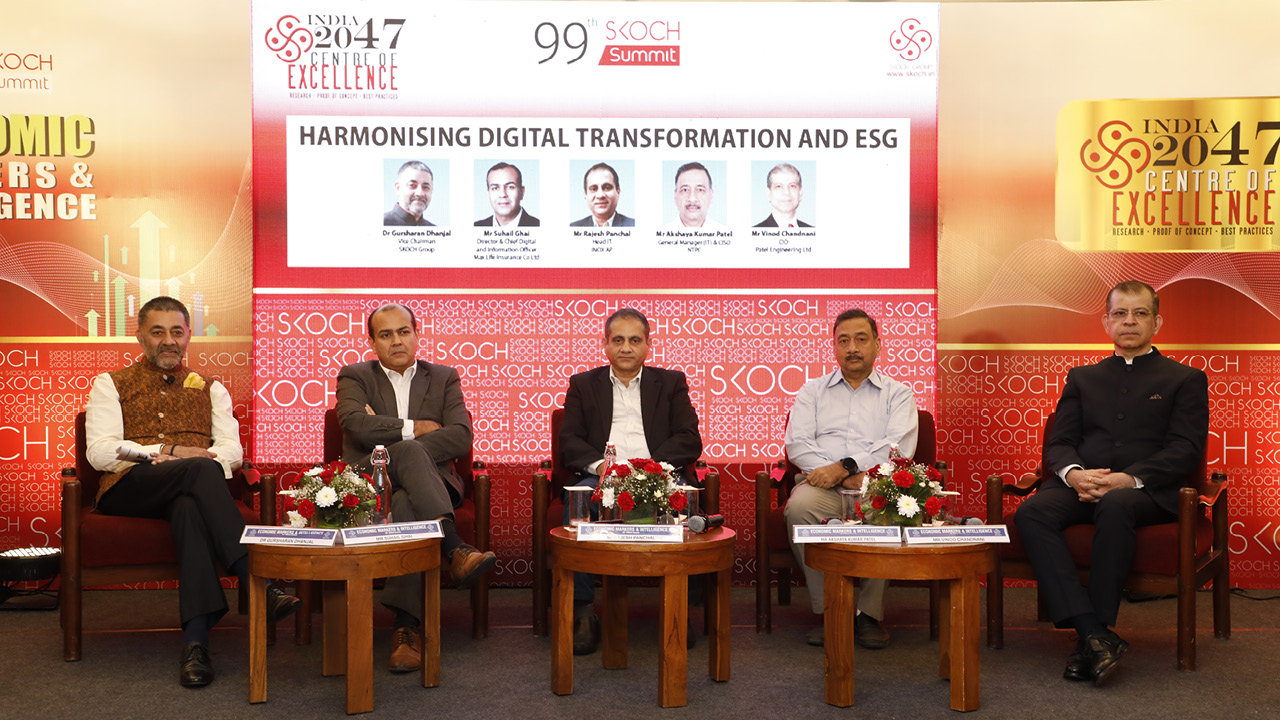
Harmonising Digital Transformation and ESG
Moderator: Dr Gursharan Dhanjal, Vice-Chairman, SKOCH Group

Mr Rajesh Panchal, Head IT, INOX AP

Mr Vinod Chandnani, CIO, Patel Engineering Ltd

Mr Suhail Ghai, Director & Chief Digital and Information Officer, Max Life Insurance Co Ltd

Mr Akshaya Kumar Patel, General Manager (IT) & CISO, NTPC

Summary: This session examined how digital transformation, ESG, and corporate digital responsibility must be addressed together rather than in isolation. It highlighted how global ESG indices often fail to reflect India’s scale, digital maturity, and development context. The panel emphasized that ESG is only credible when supported by strong digital systems that ensure transparency, accountability, and measurable outcomes. India’s digital public infrastructure—Aadhaar, UPI, eKYC, and cloud platforms—was cited as a major enabler of inclusion, efficiency, and sustainability. Digital transformation was shown to reduce paper use, energy consumption, and operational costs while expanding access to remote populations. Corporate digital responsibility, including data privacy, consent, digital wellness, and cybersecurity, emerged as a critical missing layer in current ESG frameworks. Real-world examples, including pandemic oxygen supply management, demonstrated how technology can align economic performance with social impact. The panel also flagged governance adoption and ESG reporting capacity as weak points needing ecosystem-wide improvement. Concerns were raised about ESG becoming a compliance checkbox driven by external auditors rather than internal capability. The discussion concluded that future competitiveness will depend on integrating AI, cloud, cybersecurity, and skills development into ESG strategy.*
1430 - 1600
Financial Deepening Indicators for India
Moderator: Dr Gursharan Dhanjal, Vice-Chairman, SKOCH Group
Mr Lokesh Krishna, General Manager - FGMO, Bank of India

Mr K Pramod Reddy, Chairman, Chaitanya Godavari Grameena Bank

Mr Manoj Pasangha, Deputy Chief Executive Officer, IIFL Samasta Finance Ltd

Mr Rahul Johri, Chairman, Vector Finance Pvt Ltd

Summary: This panel framed financial deepening as the widening and diversification of formal financial products and markets as the economy grows. It distinguished deepening from basic inclusion, stressing that banking access alone is insufficient without active usage, savings mobilization, credit absorption capacity, and risk coverage. The discussion referenced India’s progress since Jan Dhan and digitalization, while noting that credit-to-GDP and insurance penetration still lag peer economies. Panelists emphasized that “micro” products—micro savings, micro insurance, and micro credit—are central because they represent the financial reality of most households. A recurring constraint was the high cost of capital and high operating expenses, especially in microfinance, driven by field-heavy models and rising credit costs during shocks like floods, pandemics, and demonetization. Digitization was presented as the main lever to reduce opex, raise frontline productivity, and improve collections, while credit bureaus and employee bureaus can reduce risk and defaults. Several speakers argued that deposit growth lagging credit growth is a concern, but also cyclical and regionally uneven, with a need to bring informal savings into the formal system through deeper outreach. The panel highlighted the need for customized products based on local risks (e.g., flood-linked home cover vs hospital cash) rather than one-size-fits-all offerings. It also stressed that financial literacy must be continuous and paired with loan utilization checks to prevent consumption misuse and over-indebtedness. A key gap identified was weak adoption of investment and financial planning products, even among educated groups, implying much larger barriers for mass-market households. Risk mitigation was flagged as the most under-adopted pillar because premiums feel unaffordable and insurance is often treated as investment, not protection. The overall conclusion was that India has moved forward materially, but must accelerate product relevance, affordability, literacy, and digital delivery to deepen finance at scale.*
1600 - 1800
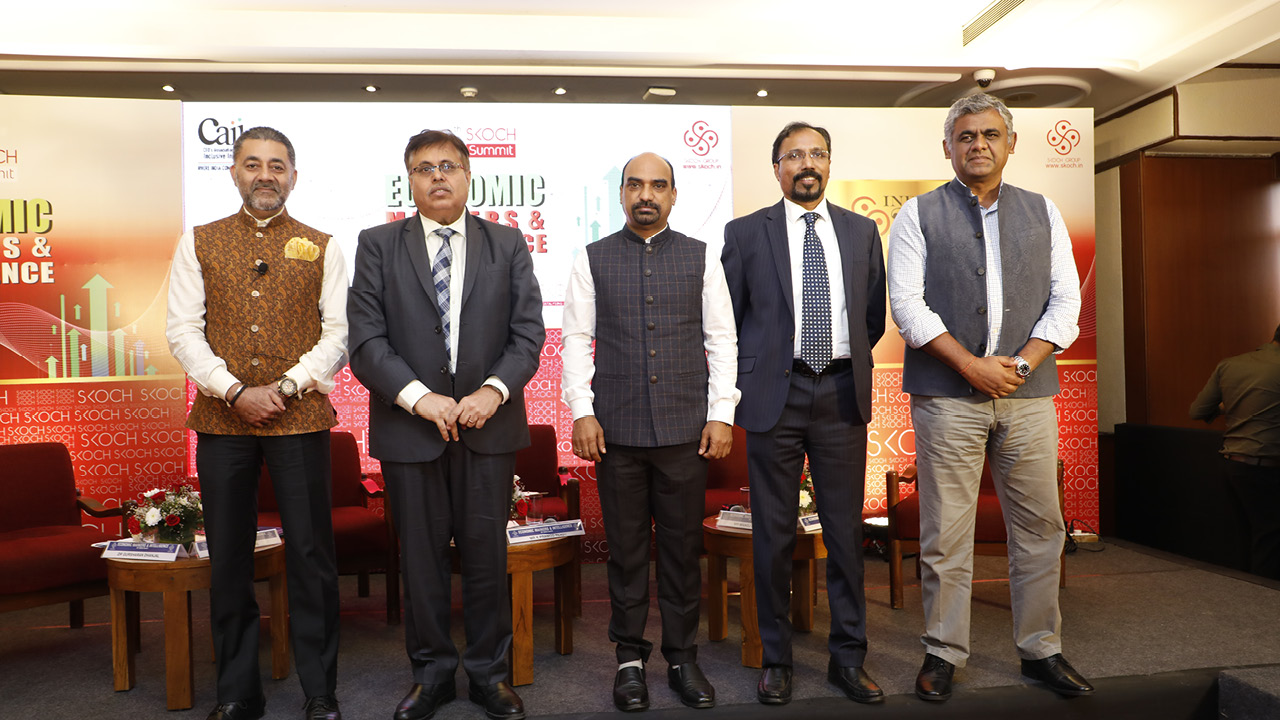
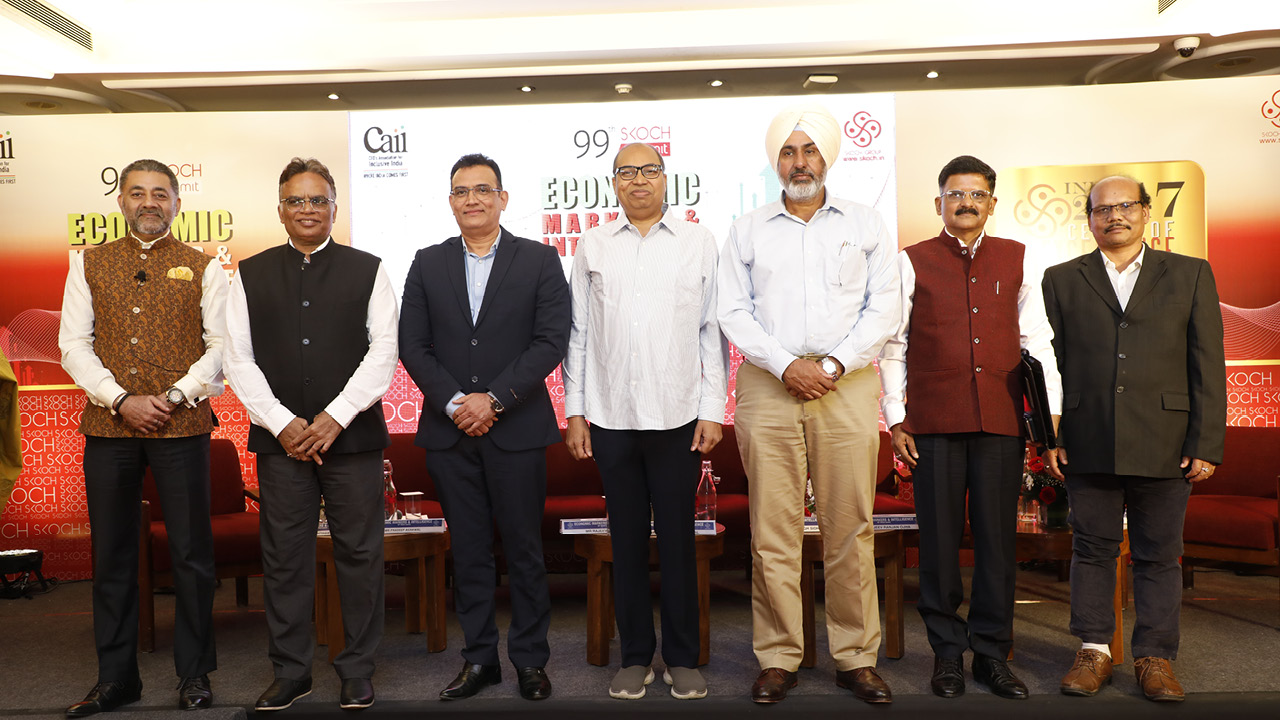
Economic Markers and Development Dashboards
Moderator: Dr Gursharan Dhanjal, Vice-Chairman, SKOCH Group
Mr Rajeev Ranjan, Principal Secretary, Labour Department, Government of Haryana

Mr Manvesh Singh Sidhu, Secretary, Building and Other Construction Welfare Board, Government of Punjab

Dr Mangesh Manohar Gondavale, Managing Director, The Maharashtra Agro Industries Development Corporation Limited

Mr Sanjeev Ranjan Ojha, Director General of Prisons & Correctional Services, Government of Himachal Pradesh

Mr Pradeep Agrawal, Director - Projects, NRIDA, Ministry of Rural Development

Mr Sudam Charan Mandal, Special Secretary, Food Supplies and Consumer Welfare Department Odisha

Summary: The panel positioned economic markers as practical tools for evaluating real development rather than abstract numbers, explaining how development dashboards convert data into visible, shared feedback for all stakeholders. They emphasized that dashboards support real-time insight, informed decision-making, and collaboration, yet are often neglected due to an excessive focus on implementation. Key macro indicators such as GDP, employment, inflation, interest rates, and poverty were highlighted, along with social indicators like health, education, and life expectancy, environmental indicators including water access and sustainability, and governance indicators such as rule of law and corruption. The speaker stressed that policy-making depends on reliable, adequately interpreted data and stakeholder feedback, and that dashboards must remain consistent across sectors even as administrators move between domains. They also underlined the importance of district- and state-level measurement, noting that while infrastructure dashboards capture outputs, they must evolve to reflect qualitative outcomes and real social impact on the ground.*
* This summary content is AI generated. It is suggested to read the full transcript for any furthur clarity.
Mr Sameer Kochhar
Chairman, SKOCH Group
Reforms historian and author of best-seller ModiNomics, Sameer Kochhar is Chairman, SKOCH Group. He is a passionate advocate of social, digital and financial inclusion and is a foremost expert on governance and inclusive growth. His work has been acclaimed globally and endorsed by Mr Narendra Modi, Mr M Venkaiah Naidu, Dr Manmohan Singh, Mr Arun Jaitley, Mr P Chidambaram, Mr Yashwant Sinha, Dr C Rangarajan and Dr Montek Singh Ahluwalia and so on. In his thinking and writings and activities, his profound admiration for India's economic reforms and in extension, those outstanding personalities who strive to make these reforms more meaningful and broad-based comes out clear and unambiguous.
View MoreDr Saurabh Garg
Secretary, Ministry of Statistics and Programme Implementation (MoSPI)
Dr. Saurabh Garg is the Secretary of the Ministry of Statistics and Program Implementation, Government of India. An IAS officer of Odisha Cadre, Dr Garg has held key positions, including Secretary of Social Justice and Empowerment and CEO of the Unique Identification Authority of India (UIDAI). He played a pivotal role in enhancing Aadhar’s technology infrastructure and driving digital solutions for agriculture and farmers’ welfare in Odisha. With a Ph.D. in International Economics from Johns Hopkins University, an MBA from IIM Ahmedabad, and a B.Tech. from IIT Delhi, Dr. Garg brings rich expertise in public policy, digital transformation, and economic development.
View MoreMr Bharat Lal
Secretary General, CEO, National Human Rights Commission (NHRC)
Mr Bharat Lal, Secretary General and CEO of the National Human Rights Commission (NHRC), joined the Indian Civil Service in July 1988. He previously served as Secretary to the Lokpal of India and was the founding Mission Director of the Jal Jeevan Mission, a $51 billion initiative to ensure clean tap water for every household by 2024. Mr. Lal has extensive experience in water management, having led reforms in the drinking water and sanitation sectors in Gujarat. His leadership in post-earthquake water initiatives earned global recognition, including the United Nations Public Service Award. He also worked closely with the Prime Minister on managing the COVID-19 pandemic.
View MoreMr Tanmay Bhargav
CTO and Head - TechSales, Hitachi Vantara, India and SAARC-Region
Sanjay Agrawal is the Technology Head for India & SAARC at Hitachi Vantara, India. Sanjay joined Hitachi Vantara in 2017 and brings with him over 30+ years of industry experience.
View MoreMs Radha Abrol
Managing Director, Accenture
Radha is a Managing Director in Accenture Operations responsible for end-to-end delivery of clients in her portfolio. She is an accomplished Finance Leader with 28 years of diverse experience across domains and industries – Accenture, Microsoft, American Express, Coca-Cola, Tupperware & PwC. She has rich knowledge in Strategy, Finance, Compliance and Operations. Radha is a qualified Chartered Accountant.
View MoreDr Gursharan Dhanjal
Vice Chairman, SKOCH Group
Dr Gursharan Dhanjal, MA, M.Phil, PhD from Delhi University, an expert in development economics. He is Vice Chairman, SKOCH Group. He is also Editor of INCLUSION—a quarterly publication that focuses on inclusive growth related areas. He has led various research projects, impact assessments and field studies in MSMEs, women empowerment, entitlements, rights, sanitation, social inclusion, health, financial inclusion, e-governance and ICT for development that included traversing across the country, collecting citizen voices for over two decades now. A prolific writer, Dr Dhanjal has contributed over 200 columns in leading national dailies including The Hindustan Times, The Times of India, The Financial Express and The Pioneer. He has published research papers in several journals of repute in addition to authoring following widely acclaimed books: Tarapur: The Politics of Nuclear Age; and, Infrastructure and Governance. He was member of the Working Group on ICT in Higher Education constituted by Planning Commission for the 12th Five Year Plan.
Mr Suhail Ghai
Director & Chief Digital and Information Officer, Max Life Insurance Co. Ltd
Mr. Suhail Ghai is the Director & Chief Digital and Information Officer at Max Life Insurance Co. Ltd., with over 20 years of experience leading IT and digital transformation projects across BFSI and FMCG sectors. He has a strong background in managing large IT teams and driving technology and business transformation agendas across multiple geographies and cultures. Suhail has extensive experience in ERP implementation, supply chain optimization, and managing IT portfolios. He excels in aligning IT strategies with business goals, managing IT budgets, and overseeing large-scale technology projects. Suhail is also skilled in vendor management and delivering global support for diverse business functions.
Mr Rajesh Panchal
Head IT, INOX AP
Mr. Rajesh Panchal is the Head of IT at INOX AP, with over 33 years of experience in global IT leadership. He has spent more than 27 years driving organisational growth by leveraging IT, focusing on SAP, business process integration, digitalization, and IT architecture. Rajesh has successfully formulated and implemented IT strategies, including cloud and mobility solutions, and played a key role in mergers, acquisitions, and regulatory compliance. He has worked with 26 international teams, integrating IT solutions across multilingual environments. His expertise spans IT strategic planning, operations management, and delivering future-ready IT infrastructure for business excellence.
Mr Akshaya Kumar Patel
General Manager (IT) & CISO, NTPC
Mr. Suhail Ghai is the Director & Chief Digital and Information Officer at Max Life Insurance Co. Ltd., with over 20 years of experience leading IT and digital transformation projects across BFSI and FMCG sectors. He has a strong background in managing large IT teams and driving technology and business transformation agendas across multiple geographies and cultures. Suhail has extensive experience in ERP implementation, supply chain optimization, and managing IT portfolios. He excels in aligning IT strategies with business goals, managing IT budgets, and overseeing large-scale technology projects. Suhail is also skilled in vendor management and delivering global support for diverse business functions.
Mr Vinod Chandnani
CIO, Patel Engineering Ltd.
Mr. Vinod Chandnani is the Chief Information Officer (CIO) at Patel Engineering Ltd., with over 27 years of international experience in IT and HR. He specializes in using design thinking and digital transformation to solve complex problems and drive capital-efficient growth. Vinod is skilled in implementing large-scale initiatives that enhance data visibility, automate workflows, and improve operational efficiency. He is passionate about continuous improvement, talent development, employee engagement, and fostering diversity and inclusion. With a strong leadership background, Vinod has successfully built collaborations within cross-functional, multicultural teams in matrix environments to achieve organizational excellence.
Mr K Pramod Reddy
Chairman, Chaitanya Godavari Grameena Bank
K. Pramod Kumar Reddy is the Chairman of Chaitanya Godavari Grameena Bank (CGGB), bringing extensive experience in banking and a solid educational background with an MSc in Agriculture and CAIIB certification. Previously, he served as General Manager at Union Bank of India, where he managed critical departments like Deposit Mobilisation and Recovery, and led regional operations in Telangana and Tamil Nadu. Mr Reddy is known for his innovative approach, including his role as Project Head of the Lead Management System and his contributions to drafting the Recovery Policy 2024. His strategic influence is highlighted by his membership in key committees, including the Internal Advisory and Credit Approval Committees at Union Bank of India.
Mr Lokesh Krishna
General Manager - FGMO, Bank of India
Mr Krishna, a seasoned banking professional, has over 32 years of diverse experience across various banking sectors, including retail, agriculture, MSME advances, and treasury management. He has held several key roles, including Branch Manager and international assignments in Jakarta and New York. Shri Krishna is a Certified Anti-Money Laundering Specialist and holds certifications in Advanced Wealth Management, IT & Cybersecurity for CXOs, and a Diploma in Treasury Investment & Risk Management. He joined the banking sector on May 11, 1992, and has since demonstrated expertise in both domestic and overseas banking operations.
Mr Manoj Pasangha
Deputy Chief Executive Officer, IIFL Samasta Finance Ltd
Mr. Manoj Pasangha is IIFL Samasta's Deputy Chief Executive Officer. He has over 28 years of multi-industry work experience ranging from the Australian News Corp to Ansett Airlines. He was serving as the Executive Vice President & COO - SZ of Bharat Financial Inclusion Ltd, which is India's largest and first public listed MFI. He had also promoted his own hospitality business at Australia. He was an associate of Standard Chartered Bank after returning to India.
Post this, at ING Life India he was spearheading many novel urban concepts and significant rural initiatives in the Alternate Channel Business as Vice President. Mr. Pasangha has also served as the Vice Chairman of AKMI (Association of Microfinance Institutions in Karnataka). Manoj has Bachelors in Commerce and a Post-Graduation in Business Accountancy, Hospitality Management, Public Relations, Publicity and Promotions from Australia.
Mr Rahul Johri
Chairman, Vector Finance Pvt. Ltd.
Rahul Johri has vast experience in financial sector and is a serial entrepreneur. He has been in financial services for more than 33 years out of which for more than 30 years was in leadership positions across banks such as Bandhan Bank, DBS Bank, Barclays Bank, Standard Chartered Bank and ANZ Grindlays Bank. He has worked in various facets of banking like strategic business planning, management of retail business, distribution planning and management, operations and customer service. During his last banking assignment of 2 years and 7 months with Bandhan Bank, he was responsible for entire Business of the Bank including the microfinance business. Under his leadership, the Bank grew the distribution network to more than 3900 Banking outlets with a Balance Sheet size of Rs 64000 crore. He was a part of the core management team for deciding the Bank’s future strategy. He also played a leadership role in Bandhan Bank’s successful transition from a NBFC-MFI to a Universal Bank. Rahul is an alumnus from IIT, Kharagpur and XLRI, Jamshedpur.
Mr Rajeev Ranjan
Principal Secretary, Labour Department, Government of Haryana
He was Commissioner of Gurugram and Rohtak Divisions, CMD of Haryana Minerals Ltd, and Commissioner Secretary to the Social Justice and Empowerment Department. He also served as the Chief Electoral Officer for Haryana, enhancing his reputation as a versatile and effective leader in governance and public administration.
Mr Manvesh Singh Sidhu
Secretary
Building and Other Construction Welfare Board, Punjab
Mr Manvesh Singh Sidhu, Secretary Labour Punjab; 2004 Batch IAS officer; Nearly 30 years of experience in Administration and Public service; Special interest in Public Policy.
Dr Mangesh Manohar Gondavale
Managing Director
The Maharashtra Agro Industries Development Corporation Limited
He was earlier Joint Managing Director of MSEDCL. As CEO of Zilla Parishad Aurangabad, he managed the COVID-19 crisis and led the Grassland Ecosystem Management project, shortlisted for the Arun Bongirwar Public Services Excellence Award. He played a key role in Maharashtra's GST implementation and has represented India internationally on taxation.
Mr Pradeep Agrawal
Director - Projects, NRIDA, Ministry of Rural Development
Mr Pradeep Agrawal, is Joint Director General in the Military Engineer Services, currently on deputation with the Ministry of Rural Development, as Director-Projects, overseeing the pan-India implementation including project monitoring and contract management of the Pradhan Mantri Gram Sadak Yojana (PMGSY).
Mr Sanjeev Ranjan Ojha
Director, General of Prisons & Correctional Services, Himachal Pradesh
With an MBA, and an M. Phil in Public Administration, he has been the recipient of the Police Medal for Gallantry and the UN Medal for Peacekeeping in Bosnia. His extensive training includes courses at LBSNAA and NPA, and international programs in the USA and Italy. Notably, he led successful anti-terrorist and anti-extremist operations and has been instrumental in managing conflicts and training initiatives in various high-stakes environments.
Mr Sudam Charan Mandal
Special Secretary, Food Supplies and Consumer Welfare Department Odisha
With 28 years of service, Mr. Mandal earlier served as Secretary, State Khadi & Village Industries Board and Registrar at MKCG Medical College. His training includes programs at O.P. Jindal Global University, NIRD-Hyderabad, and ILO's study tour to South Korea.