SKOCH Summit

Ms Radha Abrol
Managing Director, Accenture
Radha is a Managing Director in Accenture Operations responsible for end-to-end delivery of clients in her portfolio. She is an accomplished Finance Leader with 28 years of diverse experience across domains and industries – Accenture, Microsoft, American Express, Coca-Cola, Tupperware & PwC. She has rich knowledge in Strategy, Finance, Compliance and Operations. Radha is a qualified Chartered Accountant.
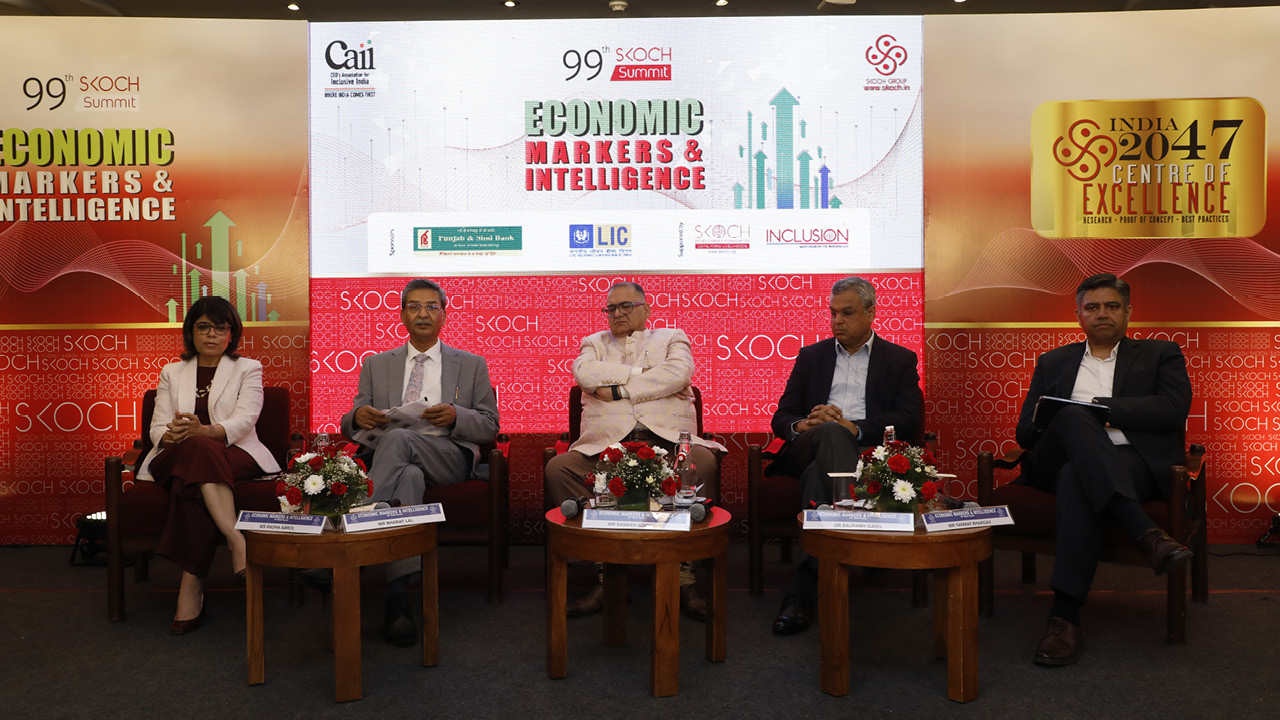
Ms Radha Abrol at the 99th SKOCH Summit: Economic Markers & Intelligence
Ms Radha Abrol
Managing Director, Accenture
Key Points*
- The speaker reflects on India’s transformation since the 1970s–80s and expresses pride in the country’s digital progress.
- She emphasizes how Digital India is often misunderstood by the West despite real grassroots adoption.
- Personal experience during COVID highlights children’s deep exposure to online gaming and virtual worlds.
- Young gamers are highly vulnerable due to lack of transparency, tracking, and awareness in gaming platforms.
- Strong regulation is urgently needed for data protection, financial transactions, and content standards.
- Global gaming regulation is fragmented, with no country having a holistic end-to-end framework.
- India lacks comprehensive, industry-specific gaming regulations and must urgently address this gap.
- Regulation must balance consumer protection with innovation to avoid stifling industry growth.
- Mental health, child safety, privacy, and human rights must be central to gaming regulation.
- Retrospective GST taxation on gaming is harmful, creates uncertainty, and discourages investment and innovation.
* This content is AI generated. It is suggested to read the full transcript for any furthur clarity.
Transcript
Thank you so much for having me over. It’s been an incredible morning. Even the conversation I had with you before we came into this room was very exhilarating for me, and therefore, whatever I’ve heard this morning makes me want to change my introduction. I don’t want to call out my corporate achievements or whatever I’ve done in the last 28 years. I think I’m a proud daughter of India who grew up in the 70s and 80s and has seen the transformation of India, and that’s what makes me very proud.
Another thing I want to share with you is that I’m an army officer’s daughter, so I grew up hearing “Jai Hind” all the time, and I heard my father always say that the color of his blood was olive green. Therefore, today, when I walked into this room, I thought, you know, a room of civilians is not what we usually see when we grow up in the Army fraternity, but I’m so happy that I came here and I’m seeing so much happening. Not only with the government—because sometimes I feel a bit dejected that they are not able to change the narrative the way I would like them to—but incredible work is being done by Scotch, by Samir, and let us see how we can partner more and really take this journey forward.
So that’s what I wanted to share. Another thing I wanted to tell you, and this carries forward what Samir started with in the morning about Digital India and how the West misreads us—this morning my domestic help, I call her my staff, was taking a train from Odisha to Delhi. The train was late by a few hours, so I called her in the morning and I said, “Ab check karo aur track karo.” So, you know, this is our India. It’s okay, I know there’s a lot of inequality, but by 2047 I hope we are around, and we are able to see so much more progress.
Now, with that, I’m going to get into the topic that has been assigned to me, which is regulation in digital gaming. You already heard the previous speaker talk about it in great detail, so to make sure that I’m not repetitive, I’m going to keep it short. I assume the audience is intelligent enough to have grasped what he said, but I will touch upon aspects where I think we need to talk a little bit more.
Regulation absolutely is critical, and here too I want to tell you a quick story which I think would resonate with a lot of you who have growing-up teenagers at home. I have one at home as well. When COVID hit us, the kids found their world in the virtual world. We were not prepared to really see what was happening in their world. They suddenly had computers at their fingertips and were on their computers for 12 to 14 hours a day. They were doing their schoolwork—which was hardly 5–10%, that was all a pretense—and they were exploring the world of gaming. At least that’s what my son did. He was in grade eight at that time in 2020.
I saw him go into this deep, dark world, as I call it as a parent. I was extremely nervous because nobody really knows much about this—where is he going, what are these games he’s playing, who is he interacting with, is he really getting into all these money transactions? So many questions, so many unanswered, even today. He’s become an avid gamer today; he’s in grade 12. We’ve had an agreement with him that till his boards get over, he’s got to put gaming a little behind. But I think the kids of today are very vulnerable, and this whole space needs very strong regulation.
That’s why I’m thankful and happy to hear that the government is thinking about it, and Samir, you are doing your bit as a private citizen to throw light on it. So why the need? The need for data protection, the need for monitoring financial transactions—everything is so opaque, nothing is in the open, currencies cannot be tracked. So much can happen in this big, dark world, as we call it. What is really responsible gaming, and how do we ensure standards for content—for young gamers and not-so-young gamers? We’ve got to take care of all of this.
Interestingly, across the globe, regulation is very fragmented. I don’t think any country really has strong gaming regulation. They have it in bits and pockets, addressed in a very non-standard, fragmented way. The main headings we need to look at—whether it’s gaming licenses, gambling, content and age appropriateness, anti-money laundering—you’ll see that different countries have something or the other. The UK may have something, Germany may have something, Singapore, the EU, etc., but nobody has a holistic, end-to-end view. And you don’t even see India very visible there.
Looking inward at India, there’s so much more ground to cover. Data protection—data is the new currency, it’s our wealth, more valuable than money or gold—and here again we are totally vulnerable. We need strong regulation. Consumer protection, protection of our children, their mental health, human rights—all of this has to come together. It’s a mammoth task, and we saw it in the framework that Samir presented to us. We really have to get going in this area.
Gaming is multifaceted, complex, and the landscape is extremely complex. We have to take care of content, age appropriateness, financial vulnerabilities, privacy, and consumer protection. In India, the time is now. We are already late, but we need to prioritize and expedite.
We don’t have industry-specific guidelines yet. The first thing we are seeing in many years is the framework that Scotch has built—it’s comprehensive and very well thought through. At the same time, we need to balance innovation. Too much regulation can kill innovation. Making India a hub for gaming, generating revenue in the right way—too much regulation will kill all that. The government and bodies framing regulation have to keep this balance in mind.
We also have to manage anonymity and privacy concerns. Too much anonymity can create problems, but privacy must be protected. How do we ensure cross-jurisdictional enforcement? That’s another open topic. Emerging technologies bring new risks—new currencies coming up every other day that can’t be tracked. These are serious challenges.
For India specifically, many questions need answers: who should be the regulators, which ministries, which agencies? Should it be a central subject or a state subject? We are a federal country—how do we manage this across states? And again, balancing innovation with regulation is critical.
Most importantly, as parents, we are worried about the mental health of our children. Human rights bodies must have an equal place at the table when regulation is made. Do we start awareness in schools? Children don’t think they’re underage. Do they even know what they are exposed to—predators, financial risks, and the law of the land? These are all issues we must consider.
Finally, I want to touch upon the burning issue already discussed—the retrospective change in GST rates. I strongly do not support this. Retrospective taxation sends a terrible signal. It puts pressure on the industry, discourages investment, and kills innovation. In a developed democracy, this should not happen. There is Section 11A, which gives the GST Council the power to reconsider and withdraw this mandate. Asking gaming companies to cough up ₹1.1 lakh crore for something already taxed and accepted earlier is not fair.
To prevent such issues in the future, we need regulation—clear, prospective, and predictable. With that, I’ll end here. Thank you so much, and we must keep in touch.