SKOCH Summit

Mr Bharat Lal
Secretary, Ministry of Statistics and Programme Implementation (MoSPI)
Mr Bharat Lal, Secretary General and CEO of the National Human Rights Commission (NHRC), joined the Indian Civil Service in July 1988. He previously served as Secretary to the Lokpal of India and was the founding Mission Director of the Jal Jeevan Mission, a $51 billion initiative to ensure clean tap water for every household by 2024. Mr. Lal has extensive experience in water management, having led reforms in the drinking water and sanitation sectors in Gujarat. His leadership in post-earthquake water initiatives earned global recognition, including the United Nations Public Service Award. He also worked closely with the Prime Minister on managing the COVID-19 pandemic.
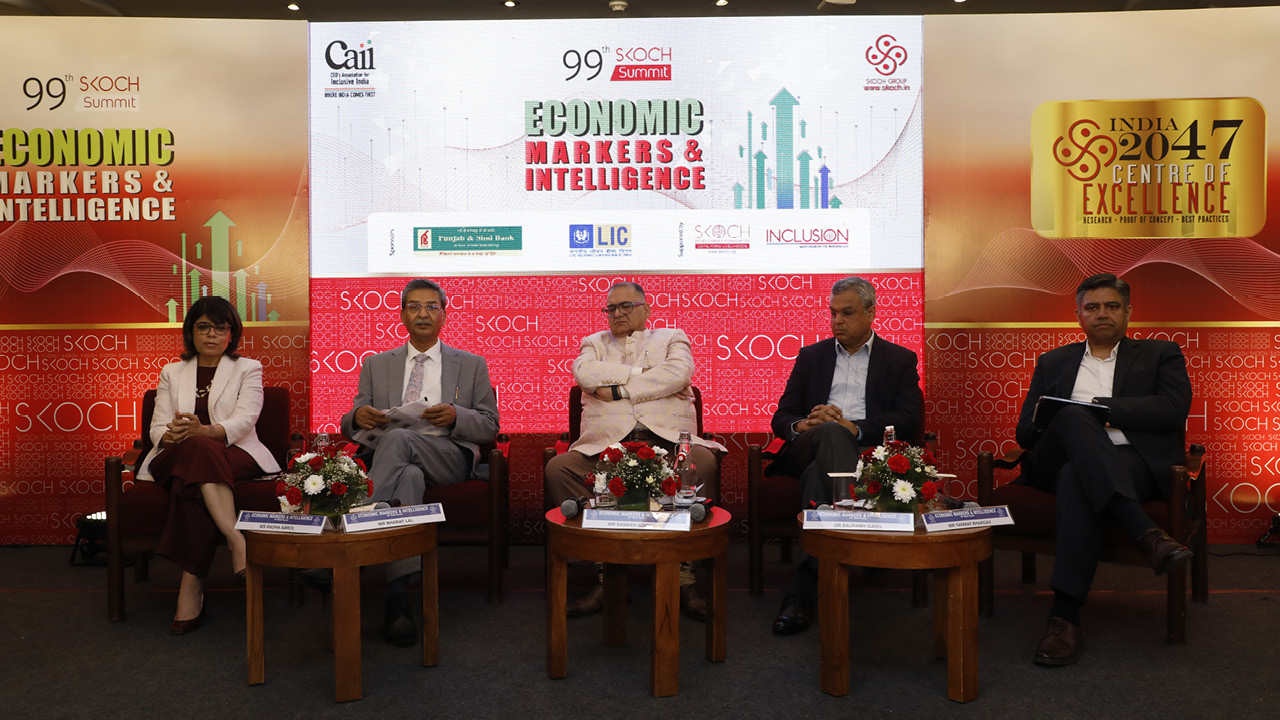
Mr Bharat Lal at the 99th SKOCH Summit: Economic Markers & Intelligence
Mr Bharat Lal
Secretary, Ministry of Statistics and Programme Implementation (MoSPI)
Key Points*
- India’s rapid economic growth must be accompanied by harmonization of business practices with human rights and sustainability.
- Global integration and supply chain participation will expose Indian businesses to non-tariff barriers linked to ESG, labor, and human rights standards.
- Rising geopolitical tensions highlight the importance of responsible and competitive business conduct.
- Mental health challenges affecting over 11% of Indians must be addressed alongside wealth creation.
- Poor labor conditions and inequality can trigger social unrest and long-term business risks.
- Climate change, water scarcity, and environmental degradation pose serious limits to sustainable growth.
- Businesses must align with constitutional values of equality, justice, liberty, and fraternity.
- Consumers and society increasingly hold businesses accountable for unethical practices.
- Sustainable, inclusive business practices are essential to ensure long-term competitiveness and social stability.
- Sustainable, inclusive business practices are essential to ensure long-term competitiveness and social stability.
* This content is AI generated. It is suggested to read the full transcript for any furthur clarity.
Transcript
Thank you for this opportunity to share a few things which ordinarily we don’t talk about. My esteemed colleagues Dr. Shab Gar, Mr. Radha Abal, and Mr. Tanay Barua—ladies and gentlemen—indeed it’s a privilege for me to be here today. In fact, for the first time I’m attending Mr. Samir Koocher’s summit, or this kind of summit. Of course, I have been associated for almost 15–16 years, but I somehow never had the opportunity to come personally.
Friends, let’s see it like this: Dr. Gur has given you a roadmap—what kind of developed India we are talking about, what are going to be the markers, and on that path how we are moving. We are moving fast: we were the 11th or 12th largest economy, from there we moved to fifth, and hopefully very shortly we should be moving to the third largest economy. In this context, of course, the Honorable Prime Minister has said that by 2047 we should become a developed country. Markers have been given, certain aspirational goals have been given, and I think we all are working with speed and scale.
The topic given to me today is the future of business, and the most important part in that future of business is harmonizing human rights and sustainability. It means I’m not supposed to talk about how businesses themselves are going to change because of technology, or because of what is happening in different countries and different parts of the world politically—whether it’s an inward-looking world or a globalized world. I’m not going to talk about that. Let me talk about this second part: harmonizing human rights and sustainability.
For a moment, think about it. Let me give you two or three scenarios. In this house, all thinking people are here—every day you develop a strategy, every day you develop your business plan, and every day you try to foresee what is going to happen.
Let me give two or three scenarios. The size of the economy: the US is a 27 trillion economy, China is a 17–18 trillion economy, India is roughly a 4–4.5 trillion economy. This is one dimension. But why is it that for the last 30 years there was hardly much tension on the business front between China and the US, or China and the West—why all of a sudden in the last 4–5 years so much stress, so much tension is there? I think you have to think about it.
It’s a matter of time: India is going to be more integrated. Everybody is saying India should be “China plus one,” part of supply chains, part of manufacturing, part of the whole ecosystem. When the India–Middle East–Europe industrial corridor develops, what kind of challenges are going to come? My talk today focuses on this aspect: what kind of challenges will we face?
We are going to face non-tariff barriers. What could be there? Human rights issues, labor laws, labor conditions, sustainability, environment, ESGs. Again, I come back: what is happening between China and the West—China and the US, China and Europe—does it have to do with competitiveness, threat, and so on? We have to see these external factors.
But the third internal factor is this: one report suggests that more than 11.6% Indians are facing mental health issues. Please—whatever wealth you want to create, you can create—but we simply can’t forget that our children, our families, and we ourselves are facing mental health issues. If not today, tomorrow or day after, ignoring mental health concerns while creating wealth may not pay off in the long term. I leave this august house to think about it.
Let me narrate one small story. Many of you will know this. A few things I’ll tell you, and a few things I’ll leave to your wisdom.
I was at that time a Principal Resident Commissioner, Government of Gujarat, promoting investment and business. Around 2011, in one of Maruti’s factories, some violence took place, and one HR manager unfortunately died. At that time, Maruti was planning, and we had discussions—they were coming to Gujarat. I went three or four times to understand why there was stress, why this problem, and what the remedy should be.
In a nutshell: two factories—one at Gurgaon and second at Manesar. At one factory, regular employees were there; for discussion, their salary was around 70,000 rupees. Very short distance—20 kilometres—and in the other unit there were contract workers, and they were earning around 30,000 rupees. They would keep meeting each other—same age group. They worked for 8 or 12 hours. In the evening, they would pick up liquor bottles, go to the dormitory, sit together and drink. It was not social drinking—it was something else. In that gathering, it turns into mob mentality: Mr. X shouted at me today, somebody abused me, third person imagined someone slapped me. Anger starts building.
These young boys, in the age group of 25 to 32, unfortunately under the influence of liquor, have no vulnerabilities—no family, no kids. In the evening they don’t need to bring a pencil box or milk or vegetables. Nobody talks about it, but it is also true that when they are not with their families, it also affects behavior, including prostitution.
When we started setting up in Gujarat and brought them, we ensured basic human rights: these young boys should have their family, they should be able to have a decent life, they should not be working only like machines. I’m proud that in India—last week only I was in Chennai—I saw institutions, especially for women and girls, creating facilities and enabling them to grow. Not only are they workers, but education, training, skilling—these things are happening.
Now, another dimension: changing climate is a reality. Somewhere in the world—California—for a few months there has been huge drought, and after that heavy rainfall and floods. Europe is seeing floods people never heard about. Forest fires are happening everywhere. In India, in Delhi where we are sitting, we have enough experience—extra rainfall, erratic rainfall, high-intensity rainfall, disruption to life.
One more small thing, which is going to disturb the kind of developed India our Constitution envisaged. Our founding fathers and mothers imagined what kind of India would be. Kindly recall the Preamble: equality, justice, liberty, and fraternity—the soul of the Constitution. Think about it: in our society, everything we are doing with speed and scale. This government at least has the sensitivity that transgender persons, beggars, trafficking girls, leprosy patients are not being left out.
My point is this: if we are thinking about becoming the third largest economy, growing at 7–8–9–10%, removing poverty, it means businesses will face challenges, and those challenges have already started coming up.
The National Human Rights Commission’s job, if I define it—please don’t mind my words—is a kind of conscience-keeper of society. The Commission requests you: please stop, take a pause, think about the people who are working with you, the environment where you are working. Take climate issues, sustainability issues, governance issues. In the last couple of months we heard so many news, and we take so much action on many issues. I don’t want to name them here, but I request you: please revisit your practices.
This 10–15 minute delivery by gig workers—what we are aiming at, what kind of society we are in—why are we not bothered about someone’s life, someone’s motorcycle, someone’s speed, someone’s back? Why? In one packaging house we sent a team and saw the kind of conditions—why?
Please understand: in this society, people are there who don’t appreciate these things. If business is not going to take care of itself, the society itself—your consumer, your customer—will take care of you.
National Human Rights Commission has a group on human rights and business where climate issues, sustainability issues, and human rights issues—we are trying to work out benchmarking, indexing, and self-regulation. In pursuit of wealth creation, we can’t afford to ignore the lives and future of our children. We cannot afford to damage our environment, where society—and business itself—becomes unsustainable.
We cannot afford to leave behind people in need. CSR funds were created for this: if in a country of 1.44 billion people there are 5–6 lakh beggars, they have to be rehabilitated. If there are transgender persons and facilities are to be given, we have to reach out.
One figure I want to share: we have 18% of the world’s population but only 4% freshwater resources. Per capita freshwater availability below 1700 cubic meters is called water stress; below 1100 is water scarcity. We are around 1400 cubic meters per person, and almost half the country is semi-arid. Water availability has become a limiting factor.
Kindly recall: 5–6 years back, NGT passed an order that in dark zones there should be no new borewells, no drilling of groundwater, and even renewal was stopped. Imagine the impact—not only on industry and business, but jobs, livelihoods, everything.
My purpose in coming is to share these concerns. These should be your concern—not necessarily that NHRC will flag it and take cognizance. That should be the second or third stage. This is the minimum we expect from all of you, and I’m sure business will respond to these requirements.
Many of you are involved in the National Action Plan on Business and Human Rights, which is under development, and we request your input and guidance. At the UN level also—Goal 8, 9, 10, 12—these Sustainable Development Goals are interlinked and directly impact your activities.
In a globalized world, I can foresee non-tariff barriers coming. India becomes a huge investment destination, you manufacture for the whole world, but the world will take those products from you only if you comply with certain standards. This meeting is going to help, and I expect you will deliberate these issues so that our businesses and industry remain competitive, expand, create opportunities for our younger generation, better opportunities, better life, and more importantly, better mental health.
I don’t want to frighten us, but the kind of data we have seen—and we are working with the National Institute of Mental Health—we are sitting on a ticking bomb. We are playing with fire. The kind of pressure and stress we are bringing to youngsters is something we have to worry about.
I’m confident you will look into it. I wish you all the very best, and I look forward to your deliberations and recommendations. NHRC would welcome them. Our purpose is improved quality of life for everyone—no one is left behind. The motto is “Sarve Bhavantu Sukhinah.”
Thank you, Mr. Kochhar, and thank you all for giving me a patient hearing. I show and appeal: kindly think over it, take a pause, think over it, work out your strategy, slightly rework it. It should not be only for saying and showing—we should mean it, because this is in our collective interest.
Thank you all very much. Have a wonderful day. Thanks.