SKOCH Summit

Mr Sameer Kochhar
Chairman, SKOCH Group
Reforms historian and author of best-seller ModiNomics, Sameer Kochhar is Chairman, SKOCH Group. He is a passionate advocate of social, digital and financial inclusion and is a foremost expert on governance and inclusive growth. His work has been acclaimed globally and endorsed by Mr Narendra Modi, Mr M Venkaiah Naidu, Dr Manmohan Singh, Mr Arun Jaitley, Mr P Chidambaram, Mr Yashwant Sinha, Dr C Rangarajan and Dr Montek Singh Ahluwalia and so on. In his thinking and writings and activities, his profound admiration for India's economic reforms and in extension, those outstanding personalities who strive to make these reforms more meaningful and broad-based comes out clear and unambiguous.
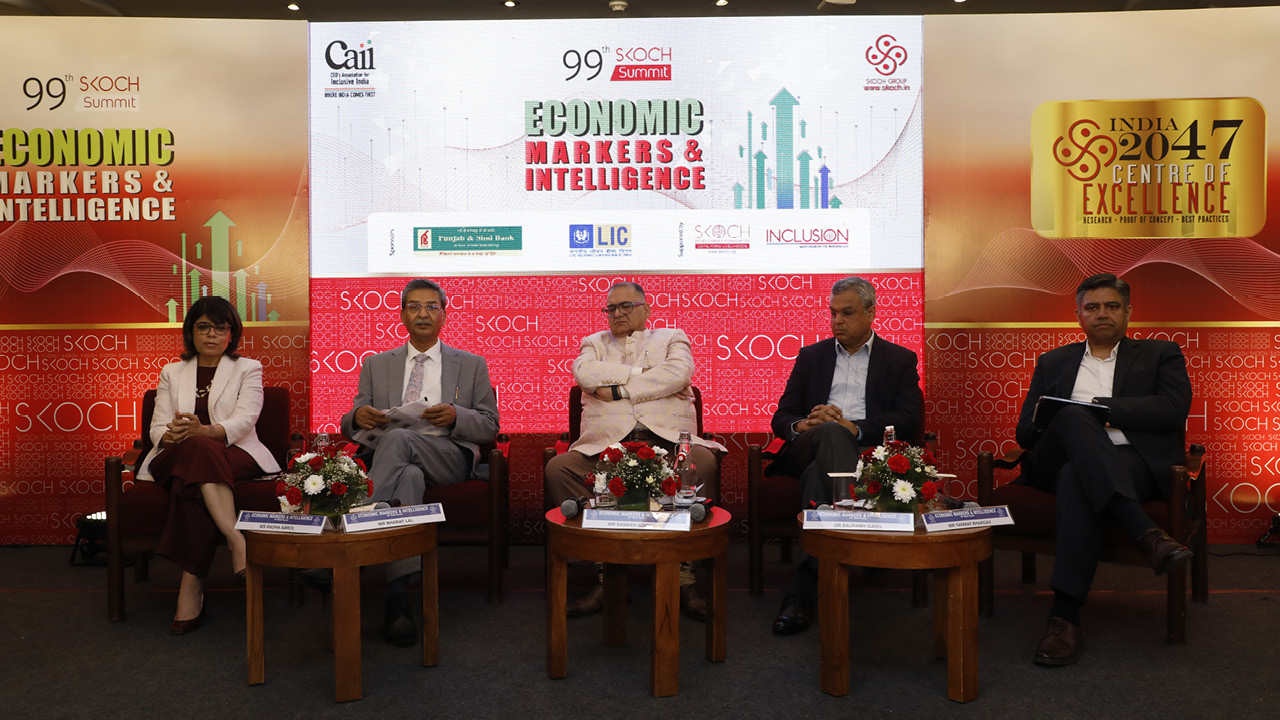
Mr Sameer Kochhar at the 99th SKOCH Summit: Economic Markers & Intelligence
Mr Sameer Kochhar
Chairman, SKOCH Group
Key Points*
- Global indices increasingly shape the India narrative and are now tied to ethics, human rights, and carbon-related non-tariff barriers.
- India’s 2047 developed-nation goal requires job-generating, spatially dispersed, sustainable, and equitable growth.
- Many global indices are flawed due to cherry-picked indicators that ignore India’s mobile-first digital reality.
- Several indices rely on opinion-based deflators and handpicked respondents, making outcomes biased and opaque.
- Global index ecosystems are heavily funded and difficult for India to counter due to scale, resources, and procurement constraints.
- Negative rankings affect sovereign ratings, investment flows, borrowing costs, and export competitiveness as non-tariff barriers.
- SKOCH shifted focus from fixing global indices to building India’s own state-level indices backed by published data and field research.
- Their method combines quantitative inputs with qualitative outcome research, using output/input to measure governance efficiency.
- New indices include state EGDI, governance efficiency, credit outreach gaps, social inclusion, hunger, and gender inequality.
- SKOCH created the world’s first responsible digital gaming framework and index, measuring compliance and quality of compliance to support better regulation and policy certainty.
* This content is AI generated. It is suggested to read the full transcript for any furthur clarity.
Transcript
Namaskar. I was 30 years old when I started doing SKOCH Summits. I’m 60 today, and we are on the 99th SKOCH Summit. Given the fact that I’m a reform historian as well, and I have been in the generation which has come up from the license-permit raj—who stood in the ration card line, stood even in the kerosene card line—to where we are today, your perspective tends to be somewhat different.
Every two years since liberalization there is a season when all these global indices start coming out, and there is this India narrative—what is wrong with India. That analysis keeps getting done in great detail. When you look at global news, you can find some kind of view that the world has, or a narrative that is trying to be built.
There’s a good thing and a bad thing. The bad thing, of course, is it leaves a bad taste, because most of this is something that you disagree with. The good thing is that at least you know what is coming at you.
What is coming next is the COP29 negotiations, and Europe has also recently passed a law where they’re saying that instead of tariff barriers, now you will actually have carbon tax, and you’ll have to have a goodness barrier, and you’ll have to have ethics, and you’ll have to have human rights, and you’ll have to have a bunch of things that were earlier not there as a part of these indices.
Therefore, I think India’s winning strategy should be to try and define these values—which are very, very Global South values, which the Global North seems to be exporting back to us—put them in the context of the Global South, and tell them, “Bosses, so how do we do that?”
The fact that India wants to be a developed country by 2047—when we say developed country, it doesn’t mean it’s just a high-income country. It is growth that has to come with job generation. It is growth that has to be spatially dispersed—no region should be left behind. It has to be sustainable, and it has to be equitable growth for India to truly call itself a developed country.
So therefore, for such a developed country, what would be the markers and what is it that we’re going to measure? I have not minced any words earlier that our statistical system really needs to catch up—indicators are dated, systems are dated—so there is an overhaul reform that is required. I’m glad to see that with Dr. Gur having taken over MOSPI and the new Statistical Commission, there is a lot of movement in that direction.
If you look at these various indices: in e-governance India is 105 out of 193 countries—I don’t think anybody in this room would even believe that. On human development we are 134. On gender inequality we are 108. On press freedom we are 159—Pakistan and Gaza are both ahead of us. Sovereign rating is Baa3. Voice and accountability is 49.2. Government effectiveness is 63.21.
For so many years these indices have been fed into us, and we believe them to be true. No one—either in the government or in the private sector—perhaps looked at these indices till about a year back, when we set up the India Center of Excellence for 2047 and started studying their indices.
We found two fundamental problems with all these global indices.
One, they have cherry-picked indicators. To give you examples: India is a mobile internet country. One key index point in EGDI is internet penetration, which is only wired. We went straight to mobile, so how can that result ever be accurate?
The second indicator is people in secondary education. What has that got to do with the Electronic Governance Development Index? Maids, drivers, elected villagers also use e-governance. There are intermediaries; they are keyboard-savvy; they are digitally literate. How many people do you know who can do nothing on a mobile phone? There won’t be any. So the parameter itself is incorrect.
On top of picking up these parameters, they use deflators. These deflators are opinion-based. So let’s say I am a research guy in the World Bank and I have three friends in India whom I used to know 50 years back. I send a survey and ask them their opinion of e-governance in India—and if you can name the respondents, you can name the result. This is not right.
It is also not relevant to the Global South because the entire India success story is solving digital at population scale. We have digital public infrastructure: Jan Dhan, Aadhaar, mobile, DigiLocker, DigiYatra, the health app, the CoWIN app—this is relevant to the Global South, but not to the Global North because they don’t have a population that large. None of this is taken into account.
Methodologies are never shared—these are obscure methodologies and handpicked respondents. So there is a big problem.
Given the patriotic zeal with which SKOCH works, we picked up all of these and said: if you look at the published data and the top 10 economies, India’s position is pretty good on most indicators. But if India’s position is good among the top 10 economies, would the other nine want India to come up? Why would they agree to these indicators being changed?
Second, the index ecosystem globally is very well oiled and gets funding of billions of dollars—UN-funded, World Bank-funded, private foundations funded, Gates-funded—depending on their leanings and ideologies. Research comes, and even research in India happens through grants of the same institutions. While there are many funding avenues for developed countries—for think tanks, universities, public intellectuals—there are none in India.
So while everybody in government would want this fixed, there is no “Ministry of Index” because it cuts across everything. Where is the budget? Who will fund it? To what extent can a country like India fund this?
Even if you create a ministry, how will you hire? Typically, you’ll find those deals go to the Big Four. And I’m not saying they are part of the Indian system in a negative way, but the Big Four and Big Tech are part of the problem, not part of the solution. Our public procurement systems allow us to hire only those guys, and not people like SKOCH. There is no comparison; there is no hope in hell of ever getting it and putting together our perspective on this.
Take the democracy index: V-Dem civil liberties. This is an organization based in Sweden, very widely funded. Post-independence we were 0.40, then it jumped because we got independence, and then during Emergency it was 0.554. Their current report says we are exactly the same today. This is incredibly stupid and impossible. Who here went through Emergency—forced sterilization? And as per V-Dem our civil liberties are the same as the period of Emergency.
Normally what happens is: I picked up all indices and mapped them together on one graph. V-Dem comes with two indices—civil liberties and democracy. V-Dem says democracy in India is going up, but civil liberties are going down. Is that even possible? Civil liberties are inverse to human development; reduction in hunger is inverse to civil liberties. Are these things even possible in India’s sense?
Their methodologies are seriously flawed. Someone has to give leadership, and to give that leadership, a lot of resources are required—billions of dollars—and very large organizations or groups of organizations are required to fix this. I don’t know whether we can build an institution like that.
Why should you care? One, all indices combined form an anti-India narrative. More importantly for businesses and states, it impacts investments. It serves as a non-tariff barrier. Therefore you can’t export, but these new barriers are coming up whether you like it or not.
So it is very important for India that as these indices evolve globally, we have a seat at the table, and the Global South leadership voice is heard. It impacts sovereign ratings, investments, cost of borrowings, and diminishes India’s true position and respect in the global order.
What are the problems in countering this? I made this data for the top 10 economies. I spoke to many people in government and they said: to be taken seriously you should do it for 193 countries. That is a problem that needs to be addressed. Even after you do that, the results will still be debatable and non-qualitative.
Also, India has little leverage in global bodies, though it has improved substantially over the last 10 years. It’s still not that you can sit at the UN and say “we want this done” and it will be done.
As I mentioned, there is no single window of ownership or appetite in government to fix this, and public procurement is against small intellectual organizations.
So what are the options for India?
One: relook, discuss, and suggest improvements in the current global indices. We have done that over the past one year.
Two: create global indices in greenfield areas where they don’t exist. We have done that in corporate digital responsibility and digital mental wellness. Human rights is an important aspect, and ours is the only index which takes cognizance of these.
Three: create Indian indices that measure global performance as a counter to existing global indices. Also global indices at the state level—India is a federal structure, so then you have to consider the state dimension.
Having done this top-level view, for the first six months of this year we gave up on the global story and focused on creating our own indices—state-level indices backed by field research.
Our methodology: first, a quantitative index based on published data; second, a qualitative index based on micro research. As you know, the SKOCH award process documents what is happening at the project level—outcomes, beneficiaries, before-and-after changes—comprehensively documented.
So the quantitative index becomes your input, qualitative index becomes your output, and qualitative divided by quantitative is your efficiency. This is perhaps the first time in the world such an exercise is being carried out.
Today we are releasing indices at the state level. One is State of Governance, which we have been doing for 20 years, and now for the first time, using revised EGDI parameters, we have done a state-level EGDI.
You will find interesting things. Odisha in State of Governance is number one, but in EGDI it is 34. Odisha is number one in the government efficiency ratio—meaning possibly it is spending money far more efficiently than somebody else: spending less, infrastructure less, outcome more.
We have calculated state by state, based on empirical data and primary research. You can’t disagree unless you bring your data.
Similarly, we have done Credit Outreach Gap—how many people lack access to formal credit sources—state by state.
Then we have done the Social Inclusive Index, which is at the grassroots of political discourse. We take the social sector as defined by RBI, look at micro-level project outcomes, and rank.
We have done the same on hunger, and the same with gender inequality and gender gap.
These indices are being introduced for the first time. Coming up next: human rights in Indian states; press freedom in Indian states; HDI of Indian states; state of panchayat; energy efficiency; health district development.
There is very little data at the district level, and our smallest unit is the district. We should at least go to the district level, if not panchayat and municipality level.
Everywhere we use the same methodology: published data for quantity, field research for quality, division for efficiency.
This would be of interest to you—human rights: India ranks 106 out of 183 countries. We studied India, USA, China, Brazil, Canada, EU, and Japan. This data will be available on our website.
These are the main parameters, and you’ll find everything is tick-marked. If you find any parameter that is not there in India, just let me know—they’re all there in India.
What will differ is the qualitative output: how well these rights are implemented. That qualitative impact cannot come out of a survey sent to five left liberals in India who answer based on ideology and then paint the entire country black. If I did the same for the USA or EU or China, you can imagine the results.
So we have defined human rights, digital wellness, environment, sustainability, and harmonization. Then we look state by state: what are the laws, what is covered, and what projects are happening, and the qualitative outcomes. Then we can give that as the India model of human rights.
We have done the same for digital gaming. There is no global framework for digital gaming; we were the first to come out with it. Globally, reporting happens on GRI indicators. The corporate sector will be happy adopting them, but we are not going to wait. We will do a baseline study.
Later today I will be presenting that baseline study. Director General of GST Intelligence has issued notices to the gaming industry for tax evasion.
So compliance becomes extremely important. A task force is underway—professional psychiatrists, Human Rights Commission, Ministry of IT—cutting across segments. You have to put citizens first, and it is also debatable whether it is a state subject or a central subject.
If a framework is defined by all stakeholders together, it is difficult to find flaws. But if you do, we are happy to correct it—remove things, add things. At least we are bringing a discussion to the table.
This is the industry-wide compliance view: 39% compliance, and quality of compliance is only 20%. Minor protection, minor compliance. This is the kind of research we are doing—this is the qualitative part.
The next part is respect for doing business. Increasingly, businesses are becoming part of policy discourse. I wrote an article recently saying respect for doing business—from Tata to Ambani, Adani, and MSMEs—because it’s not easy. Then you say: how do you prove it?
We created an index called India in the World. This is for corporate India—environment, social, governance, digital transformation, digital corporate responsibility. This is a full stack of SKOCH reporting indicators, a superset of all existing global indicators like GRI and BRSR. We are ahead of all of them.
If you measure against these indicators, we came up with a pilot baseline last year, and the second exercise is underway. We have an ethics policy.
Thank you very much.
---
So what I’m sharing with you—and I did so during the last conference also—is building India’s first digital index: the responsible digital gaming framework. Such an index does not exist anywhere in the world.
The first exercise we carried out was looking at seven large economies and their existing frameworks covering gaming, digital gaming, online gaming, and so on. We duplicated that and created a super list of indicators. Then we realized most regulations do not take into account aspects like mental health, multilingualism, local language support—important in India. You may not know a word of English but you may be playing rummy in English and losing money because of lost-in-translation issues.
So we came up with SKOCH reporting indicators—74 of them. After that, we organized multi-stakeholder workshops. Mr. Batal had kindly sent people from the Human Rights Commission. We had people from Ministry of External Affairs, Ministry of I&B, NIMHANS, universities, RIS, FISME, Swadeshi Jagran, and so forth. These workshops went over six months.
Finally, we released the framework on 13th July 2024 at the 98th SKOCH Summit.
We are now building this index in three parts.
One is compliance ratings, for which we have hired mystery shoppers—qualified professionals, lawyers and economists—who go to the top gaming apps and assess technical compliance versus the framework: for example, protection of minors—are you compliant or not?
The second part, which is subjective and opinion-based, is the quality of that compliance: how far have you gone in complying?
We have done an initial ranking of 30 gaming apps, and research on more apps is underway. The output is a discussion paper which we are discussing with multiple stakeholders and the industry. If tweaking is required after the results, we will do it.
At the same time, we have written to the industry asking for inputs. The industry is not involved in part one; the industry is involved in part two, where we hear their point of view—what they are planning to do and where they are going.
Taking these together, we will create a responsible gaming index.
This is the methodology I described. These are the 30 apps already studied. The industry average on technical compliance is 39%, and the quality of compliance is 20%. Given the framework was released only in July, in two months we find the needle has moved, and the results are encouraging.
At the same time, many other developments are happening in the gaming industry. The Director General of GST Intelligence has marked it as a high-risk industry, and very large notices have been sent. India’s position in FATF compliance has improved; it is among the top five compliance-oriented countries and will not be audited as often.
Part three is: how should gaming, a digitally native industry, be regulated? A task force is being formed—multi-departmental, including RBI, ED, Ministry of I&B, Ministry of IT, and others.
Given this, the discussion we are having today becomes extremely important.
First: what is money itself in a digital environment—traditional money or digital assets, crypto, points, offline settlements?
Second: digital-by-nature opens avenues of evasion and laundering—tax evasion, offshoring, dark web, lack of tracking and tracing.
Third: policy certainty on applicable tax rates must be there. The industry understood gaming tax was 18% and deposited 18%, and the GST department accepted 18% for years. Suddenly, they get notices saying it was actually 28%. This is impossible to implement because the tax has not been collected.
India has gone down this path before—retrospective taxation for Vodafone, the Cairn Energy case. Litigation was lost, but what was also lost was self-respect because honest businessmen were painted as tax evaders.
In the same category, notices are being sent to non-section 28 companies conducting research and receiving grants—even government grants—saying grants also have to pay GST. The person giving the grant is government, the person taking the tax is government, and the NGO is only the agency in between. Why don’t you send yourself a tax notice?
This tax activism in hindsight has to stop because it is damaging for the country narrative.
Next: what regulators come into play? Enforcement agencies are one part, but who protects citizen interest—mental health, human rights? Those regulators should also necessarily be involved.
Then: what view are the states taking? Tamil Nadu has established an online gaming authority. What are other states thinking? Should there be central regulation, or a model regulation?
Most digital-native businesses—gaming, lending, Uber—are fragmented in subject matter, but digitally there is no elegant way to regulate unless there is some centrality. What is that centrality, and how will states view it?
These are the five points we are discussing in today’s panel, and we have domain experts in each.
We start with Mr. J. Ranan—JS Online—oh, he’s not there? Okay. So let’s start with Tanay in that case. Tanay Barua is from KPMG and he has a deck talking about the status of financial intelligence and money laundering, and so on.