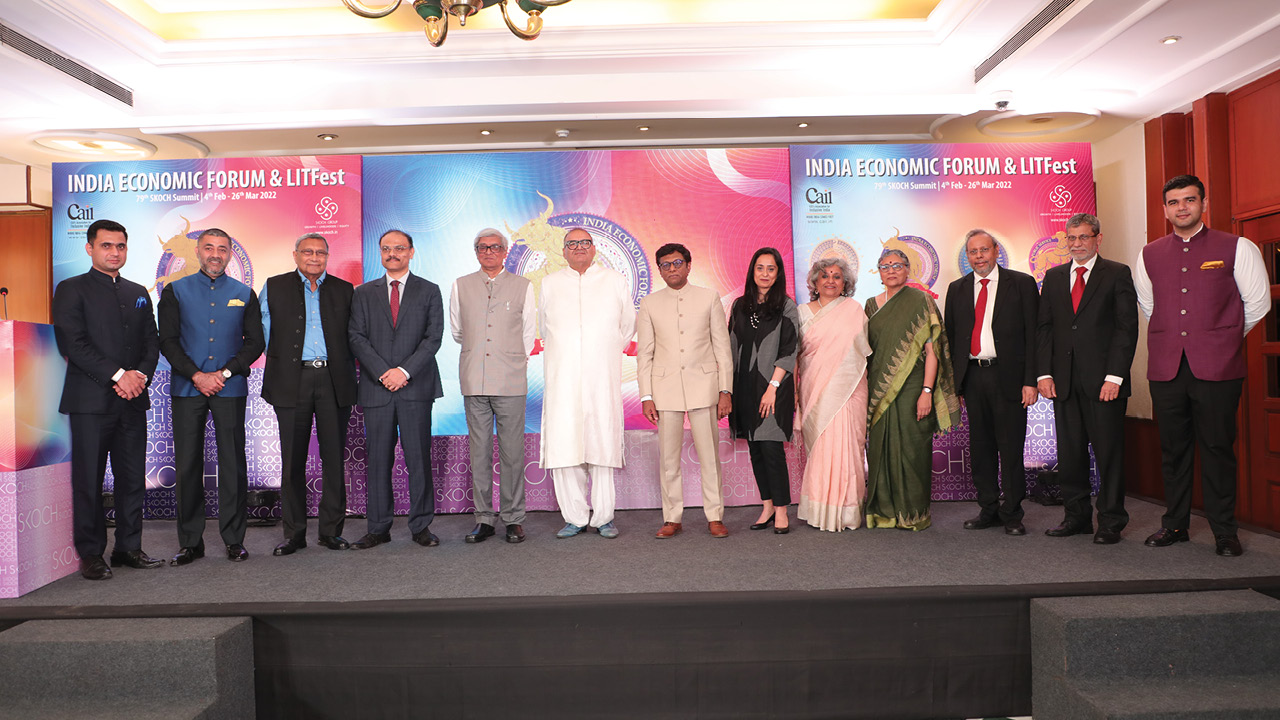
SKOCH Summit
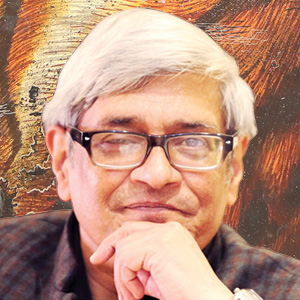
Dr Bibek Debroy
Chairman, Economic Advisory Council to the Prime Minister
Bibek Debroy is a visionary economist who has written extensively on economic growth covering the entire gamut from legal reforms to railway reforms. He was Consultant to the Department of Economic Affairs and worked on Legal Adjustments and Reforms for Globalising the Economy project by Finance Ministry and UNDP. He was the rapporteur for implementation in the Commission on Legal Empowerment of the Poor. Not only at the centre, even states have been beneficiaries of his expertise including Jharkhand, Rajasthan, Jammu & Kashmir and Gujarat. He Chaired the Committee to restructure Indian Railways. With more than 100 books and many more in the pipe, Debroy is a teacher at heart and believes in decentralisation and inclusive growth with the last person in the queue. He believes that the national income of any country is measured by the productivity of its citizens in the working age group.
Dr Bibek Debroy at the 79th SKOCH Summit: India Economic Forum - India 2047
Dr Bibek Debroy
Chairman, Economic Advisory Council to the Prime Minister
Key Points*
- SKOCH events consistently emphasize inclusion across discussions, publications, and awards.
- Poverty and inequality are related but fundamentally different concepts.
- Poverty is an absolute measure, while inequality is a relative and dynamic concept.
- Perceptions of inequality change based on expectations of future well-being.
- The core issue is understanding why people are poor, as poverty is not voluntary.
- Inclusion requires equitable access to key inputs like infrastructure, finance, and markets.
- India’s diversity makes governance and legal frameworks critical to economic outcomes.
- Markets function within the structure provided by legal and constitutional systems.
- Effective delivery of public goods depends largely on local governments, not just central or state authorities.
- Greater focus is needed on decentralization and grassroots governance to achieve true inclusion.
* This content is AI generated. It is suggested to read the full transcript for any furthur clarity.
Transcript
Good morning, ladies and gentlemen. It is always a pleasure to attend a SKOCH event. I have known Sameer Kochhar for years and years, although it is a rum thing when he decides to switch from scotch to rum.
Much of what happens at SKOCH events is, of course, a lot of bull, as you can see at the back. But one thing has always underlined everything that SKOCH has sought to do—including these events, the magazine, and the awards—which is an emphasis on inclusion.
There are many friends in the audience. I know some of them will be awarded, and several of them have written over the years. Amongst those present here, Montek is probably the senior-most. In one form or another, they have all talked about poverty and inclusion.
These two terms are related, but they are different. Poverty is an absolute notion. It has a bearing on whatever is the poverty line and how we choose to define it, which also requires data before one can estimate what percentage of the population is below the poverty line.
Inequality tends to be more contentious, but fundamentally it is a relative indicator. Inequality and perceptions about inequality not only depend on inequality in what, but also tend to be dynamic concepts. If I recall rightly, Montek himself said something like this—that if I perceive that in the future my situation will improve, or that my children will have a better life than I do, my perception of inequality changes.
Whether we are talking about poverty or inequality, the more basic question is: why are people poor? No one is voluntarily poor. Certainly no one in the working-age group is voluntarily poor, unless the person is disabled.
Effectively, it boils down to inclusion, which can be defined as removing inequity in the provision of inputs. These inputs include physical infrastructure, social infrastructure, financial inclusion, technology, credit, and access to markets.
India is a very large and heterogeneous country. Therefore, economists pay attention to governance, which is linked to legal infrastructure. Markets are conceptual notions, but they do not exist in a vacuum. The framework for a market is determined by the legal system.
I am not referring to dispute resolution speed or case backlogs, but to the Constitution itself. The Constitution has its roots in the Government of India Act of 1919, and much of what we have today is based on the Government of India Act of 1935.
What I want to highlight is the Seventh Schedule of the Constitution, which divides responsibilities into Union, State, and Concurrent Lists.
Whenever we talk about inclusion, poverty alleviation, or employment, we are also talking about the government fulfilling its responsibilities. The government must provide public goods—not necessarily in the strict economic sense—and also support deserving beneficiaries.
But what do we mean by government? There are three layers: Union, State, and local governments.
When economists talk about public spending, they often focus on percentages—6% for education, 4% for health, 10% for infrastructure. But it is not just about spending; it is about the efficiency of that spending.
Most public goods are actually delivered by local governments, not Union or State governments. However, fiscal devolution and decentralization to local bodies—panchayats and urban local bodies—are largely controlled by State governments.
My plea is that the economic fraternity and sorority should pay greater attention to governance as shaped by administration—not just in Delhi or State capitals, but at the district and block levels, and even further down.
After all, inclusion also means integrating the 125,000 villages out of 600,000 that still remain somewhat marginalized.
On this agenda of inclusion, I do not think there will be any disagreement among the economists gathered here, because that is what all of them have been writing about.
Thank you.